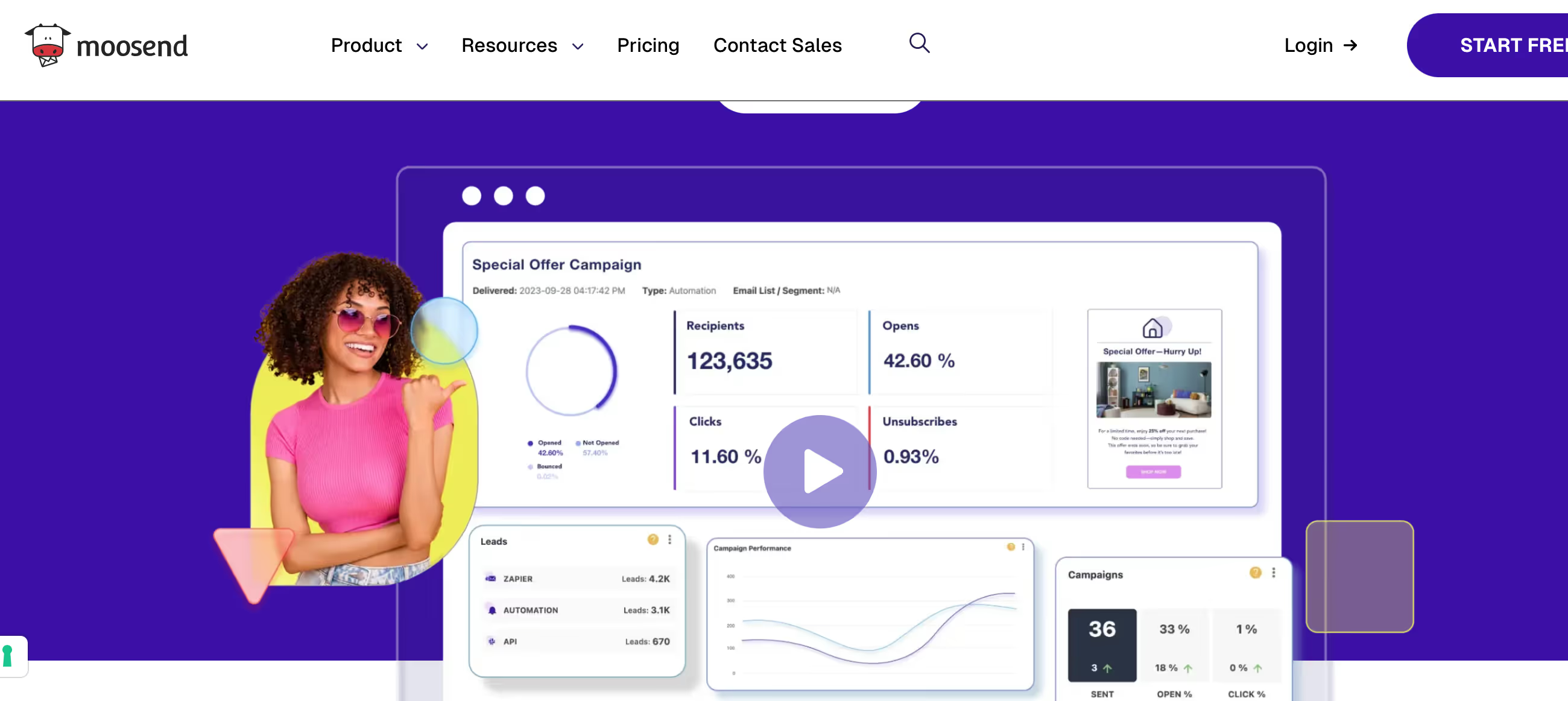
Is Moosend Right for You?
If you're a freelance marketer, you can set up cart abandonment and welcome sequences on day one for $9/month with zero feature restrictions — Moosend's all-inclusive pricing makes that possible.
But if you need CRM connectivity, a broad app ecosystem, or a free plan to start, you'll hit Moosend's limitations before you hit its strengths.
⚠ Main limitation: Only ~42 native app connections (versus 900+ at larger platforms), no CRM, no free plan, and scaling costs jump fast — from $9 at 500 contacts to $48 at 5,000. Transactional emails require a custom-priced Moosend+ plan, and templates feel dated compared to competitors.
Affordable email marketing platform with enterprise-grade workflows unlocked from day one.
Budget-conscious small businesses and solopreneurs who need powerful workflows without premium price tags, ecommerce stores running cart abandonment and product recommendation sequences…
You need a free forever plan, deep CRM connectivity, creator monetization tools, rich design templates, or a vast app ecosystem connecting dozens of business tools.
Why Moosend?
Most email platforms lock advanced workflows behind $50-100/month tiers. Moosend gives you visual workflow builders, conditional logic, behavior-based triggers, and website tracking at $9/month. That's the entire feature set on day one — no upgrade prompts, no artificial limits on what you can build.
All Features, One Price
The Pro plan includes everything: unlimited email sends, workflow builders, landing pages, subscription forms, A/B testing, and SMTP server access.
Mailchimp charges $20/month for 500 contacts and still locks workflows behind its Standard plan. Constant Contact starts at $12/month with limited capabilities. That entry price gets you what competitors charge $30-50 for elsewhere.
Fair Subscriber Billing
Moosend counts unique email addresses across your entire account. The same subscriber appearing in multiple lists or segments counts once.
This is a genuine advantage over platforms like GetResponse, where duplicate contacts across lists mean duplicate billing. You also won't pay for unsubscribed, archived, or bounced contacts — they call it their "fair subscriber policy."
The Scaling Reality
The $9 entry point is genuinely competitive, but costs escalate faster than you'd expect. At 2,000 contacts you're paying $24/month, at 5,000 it jumps to $48, and by 10,000 you're looking at roughly $88/month.
The initial savings over larger platforms narrow considerably once your list crosses 2,000 subscribers. Annual billing saves 20%, which helps — but map out your growth projections before committing.
The Verdict
8.0/10 - Moosend delivers exceptional value at budget pricing, with fair subscriber billing and solid deliverability. The limited app ecosystem, removed free tier, and rapid scaling costs prevent a higher score.
Criteria | Score | Verdict |
|---|---|---|
Value for Money | 9/10 | All features unlocked at $9/mo with unlimited sends; unmatched price-to-capability ratio in the category |
Ease of Use | 8/10 | Clean interface, first campaign in under an hour; can't save brand presets globally |
Automation Power | 8/10 | Visual workflow builder rivals platforms 3x the price; lacks fixed-date scheduling and CRM triggers |
Deliverability | 8/10 | #4 in independent tests; Gmail and Outlook can be inconsistent |
Design Flexibility | 6/10 | 130+ templates functional but dated; no global brand presets; custom HTML available |
Integrations | 5/10 | ~42 native connectors versus 900+ at competitors; Zapier fills gaps but adds friction and cost |
Support Quality | 7/10 | Live chat (24/5) consistently praised; email support gets mixed reviews; no phone support; English only |
⚠ Trade-offs: No free tier (removed "Forever Free" in 2022, angering loyal users). Aggressive anti-spam enforcement suspends accounts without detailed warnings. No migration support on Pro plan. Transactional emails require Moosend+ upgrade. No CRM, no SMS, no monetization tools for creators.
Fit by Business Type
Strong fit (8-10)
✔ Solo Creator/Freelancer (9/10) — Full capabilities at $9/mo, fair billing, and unlimited sends make this ideal for budget-conscious solopreneurs.
✔ eCommerce Store (8/10) — Cart abandonment, product recommendations, website tracking, and WooCommerce/Magento all native.
✔ Budget-Conscious Startup (8/10) — All-features-included pricing with no upgrade pressure until your tech stack demands broader connectivity.
Moderate fit (5-7)
◑ Small Business 2-10 (7/10) — Solid for small teams but limited to 5 users on Pro; Moosend+ needed for more.
◑ Mid-Sized Company (6/10) — Capabilities hold up but app limits and no CRM create friction at scale.
◑ Nonprofit (6/10) — 25% discount helps but removed free tier hurts organizations that relied on it.
◑ Agency (5/10) — Client management exists but limited native apps make multi-client workflows cumbersome.
Poor fit (1-4)
✗ Content Creator Monetizing (4/10) — No paid newsletters, no digital product sales, no tip jars; Kit or MailerLite serve creators better.
✗ Enterprise 50+ (3/10) — Custom pricing opaque, app ecosystem too thin, no advanced security on base plan.
✗ B2B Sales Team (3/10) — No CRM, no pipeline features, no sales-focused tools.
What Users Say: Reviews & Verified Experiences
User ratings: 4.7/5 on G2 (717+ reviews), 4.6/5 on Capterra (196 reviews), 3.4/5 on Trustpilot (~79 reviews). The G2-to-Trustpilot gap of 1.3 points is one of the widest in the email marketing category — a pattern that typically signals satisfied power users alongside frustrated casual customers hitting billing or enforcement issues.
Pros: What Users Love
✩ Price-to-Feature Ratio: "After going through other platforms, we decided to stay with Moosend. There's no other tool matching the feature set & price point offered," says one G2 reviewer. This sentiment repeats across hundreds of reviews — the value proposition genuinely resonates.
✩ Workflow Quality: "By using Moosend's automation and intelligent segmentation to personalize messaging for each type of customer, we were able to raise the conversion rate by over 20%," reports a Capterra reviewer. The workflow builder consistently earns praise for balancing power with simplicity.
✩ Live Chat Support: "Customer service was outstanding — less than five minutes to get live online chat and even scheduled a live onboarding call," writes a VP of Marketing on G2. The 24/5 live chat availability gets higher marks than email support across all platforms.
Cons: What Frustrates Users
⚠ Removed Free Plan Backlash: Moosend eliminated its "Forever Free" plan in 2022, locking existing free users behind a paywall with their own data inaccessible. Multiple Trustpilot reviewers from nonprofits describe feeling betrayed after years of loyalty.
⚠ Account Suspensions: "I only wish I had seen the 2-star rating here before switching. After my second campaign, they suspended my account," writes one Trustpilot reviewer. Moosend's aggressive anti-spam enforcement catches spammy imports fast but sometimes flags legitimate senders without clear recourse.
⚠ Workflow Gaps: A detailed Trustpilot review describes missing fixed-date scheduling, unreliable trigger timing, and "clumsy workarounds" needed for basic sequences — calling the system "not fit for purpose" despite praising the interface design.
⚠ Scaling Costs: "Pricing can get a little steep if your email list starts to grow," notes a Capterra reviewer. The jump from $9 to $24 at just 2,000 contacts catches users off guard when growth accelerates.
What Moosend Users Typically Achieve
You Actually Launch Campaigns (Without a Designer)
The drag-and-drop editor and pre-built templates mean non-technical teams start sending within their first session. For small businesses that kept postponing "we should do email marketing," Moosend removes the excuse. The learning curve is genuinely shallow — most of the interface just makes sense.
Mailchimp Refugees Save Immediately
The most common migration story: teams switch from Mailchimp due to pricing and logo restrictions on cheaper plans. The unlimited sends model eliminates overage anxiety that plagues volume senders on capped platforms, and the fair billing (unique contacts only) means your costs stay predictable.
Automation Runs Without Babysitting
Cart abandonment, welcome series, and re-engagement workflows genuinely run themselves once configured. The 18 pre-built recipes mean you're customizing proven frameworks, not building from scratch. Teams that previously handled follow-ups manually find the biggest quality-of-life improvement here.
Support Solves Problems Outside Business Hours
Live chat availability on weekdays — including evenings — is a consistent strength. For small businesses without dedicated IT, fast responses prevent minor issues from becoming campaign disasters. Email support gets mixed feedback, so stick with chat when you need something resolved quickly.
Open Rates Improve After Switching
Teams migrating from other platforms consistently see better inbox placement. The combination of deliverability infrastructure, built-in spam testing, and list cleaning at import helps — especially for businesses coming from platforms with weaker sender reputation management.
3 Critical Mistakes to Avoid
Mistake #1: Ignoring Scaling Costs Before Committing
Moosend's entry price is genuinely competitive — until your list grows. At 2,000 contacts you're paying nearly triple the entry cost, and by 5,000 subscribers you've crossed $48/month.
One small business started on the base plan, hit 5,000 subscribers within six months, and watched their email costs jump significantly. The initial savings over Mailchimp evaporated faster than expected.
⚠ The Fix: Calculate your 12-month list growth projection before committing. Map costs at 2,000, 5,000, and 10,000 contacts against competing platforms like MailerLite and Brevo. If you're adding 300+ contacts monthly, the price advantage disappears within a year. The 20% annual billing discount helps, but only if you're confident about staying — there's no money-back guarantee.
Mistake #2: Assuming Pro Includes Transactional Emails
Moosend's Pro plan handles marketing campaigns beautifully but excludes operational email entirely — order confirmations, password resets, shipping notifications all require a Moosend+ upgrade with custom pricing.
Ecommerce stores discover this after migration, when their checkout flow needs automated receipts they can't send from their current plan.
⚠ The Fix: Audit your full email workflow before migrating. If you send any operational emails alongside marketing campaigns, factor Moosend+ pricing into your budget from the start. Alternatively, use a dedicated transactional service like Postmark or Amazon SES alongside Moosend Pro — but that adds another tool to manage.
Mistake #3: Not Cleaning Your List Before Import
Moosend's aggressive anti-spam enforcement is both a strength and a trap. Import a list with stale, bounced, or purchased contacts and your account can be suspended — sometimes within hours, sometimes after your first campaign.
Multiple Trustpilot reviewers describe losing access after importing legitimate but uncleaned lists. The enforcement protects deliverability for everyone on the platform, but the execution lacks nuance and clear communication.
⚠ The Fix: Run your entire list through an email verification service like Bouncer, ZeroBounce, or NeverBounce before importing into Moosend. Remove any contacts older than 12 months who haven't engaged. This investment (typically $10-30 for most lists) prevents the frustration of account suspension and protects the deliverability rates that make Moosend worth using in the first place.
Frequently asked questions
How much does Moosend actually cost as your list grows?
Moosend Pro starts at $9/month for 500 contacts on monthly billing, dropping to $7/month annually. At 2,000 contacts it's $24/month, 5,000 costs $48/month, and 10,000 reaches roughly $88/month. Annual billing saves 20%, and nonprofits get an additional 25% discount stackable with annual pricing. The pay-as-you-go option starts at $350 for 350,000 credits that never expire — useful for seasonal senders. All Pro plans include unlimited email sends, full workflow capabilities, landing pages, and A/B testing.
How does Moosend compare to Mailchimp?
Moosend is significantly cheaper at small list sizes — $9/month versus $20/month at the competitor for 500 contacts with comparable features. Moosend includes unlimited sends while Mailchimp caps emails on every plan. However, the competitor offers a free plan (500 contacts, 1,000 emails), 900+ connectors versus Moosend's ~42, stronger template design tools, and a built-in CRM. The price gap narrows as lists grow, and the ecosystem advantage becomes more significant for businesses connecting many tools. Choose Moosend for budget workflow power, the alternative for connector breadth and design flexibility.
Is Moosend good for ecommerce?
Moosend handles ecommerce email marketing well with native cart abandonment workflows, AI-powered product recommendations, website visitor tracking, and WooCommerce/Magento/BigCommerce connectors. The unlimited sends model works well for promotional campaigns. The main limitation: operational emails (order confirmations, shipping notifications) require upgrading to Moosend+ with custom pricing. If your store needs both marketing and operational email from one platform, factor that upgrade cost into your comparison with Klaviyo or Omnisend which include operational email on their base plans.
Does Moosend have a free plan?
No. Moosend removed its "Forever Free" plan in 2022, replacing it with a 30-day free trial. The trial gives full Pro access with up to 1,000 contacts and unlimited sends — no credit card required. After 30 days, your account locks but data stays intact until you upgrade. This was a controversial change: nonprofits and small organizations that built workflows on the free plan lost access to their own data behind a paywall. If you need a permanently free option, MailerLite (1,000 subscribers), Brevo (300 emails/day), or Kit (10,000 subscribers with limitations) offer ongoing free tiers.
Why do Moosend Trustpilot reviews mention account suspensions?
Moosend enforces strict anti-spam policies to protect deliverability across its shared sending infrastructure. Importing uncleaned lists with stale or purchased contacts triggers rapid account suspension — sometimes within hours. The enforcement itself is defensible (it keeps deliverability high for legitimate senders), but users consistently complain about insufficient communication during the process. Accounts get suspended without clear explanation of which contacts triggered the issue, and the appeal process feels opaque. The fix: always verify your email list through a cleaning service before importing, remove any contacts who haven't engaged in 12+ months, and never import purchased lists.
Who owns Moosend?
Moosend was founded in 2011 in Greece and acquired by Sitecore (an American digital experience management company) in May 2021 as part of a $1.2 billion growth strategy. The acquisition brought enterprise backing, increased R&D investment, and access to Sitecore's global support network. The Moosend platform continues operating independently with its own branding, pricing, and team. For users, the Sitecore connection means long-term stability and ongoing development, though some industry observers note potential feature overlap with Sitecore's own marketing tools. Day-to-day, Moosend operates as a standalone product with EU-based data storage and GDPR compliance.