Is Agile CRM Right for You?
If you're a bootstrapped team of 8 needing CRM, email automation, and help desk without separate subscriptions, you can run it all for under $10/user/month. But if you need a platform that's actively evolving with modern integrations and a reliable mobile app, you'll be building on a foundation that stopped getting updates years ago.
⚠ Main limitation: The platform shows clear signs of stalled development. No visible feature updates since approximately 2021, blog posts stopped in 2019 (with sporadic additions since), the Android mobile app is defunct, the Chrome extension has been deprecated, and the feedback system (UserVoice) is shut down. Multiple reviewers and testers flag this as a red flag for long-term reliability.
✔ Get it if: You need a free CRM for up to 10 users with actual functionality (not just contact storage), you want marketing automation and help desk without paying for separate tools, your budget is under $15/user/month, or you need sales gamification and lead scoring at a price point where competitors don't offer them.
An all-in-one CRM combining sales pipeline management, marketing automation, help desk ticketing, social media tools, and telephony — all from a single platform.
You're a bootstrapped startup or small team of 5-15 people who needs CRM, email marketing, and basic customer support in one tool — and budget is your primary constraint.
You need a platform that's actively evolving with regular updates and modern integrations, you want a polished mobile experience (the mobile app is essentially dead), you need reliable third-party integrations beyond the basics…
Why Agile CRM?
Agile CRM launched in 2013, created by Manohar Chapalamadugu — the same founder behind ClickDesk, a live chat product.
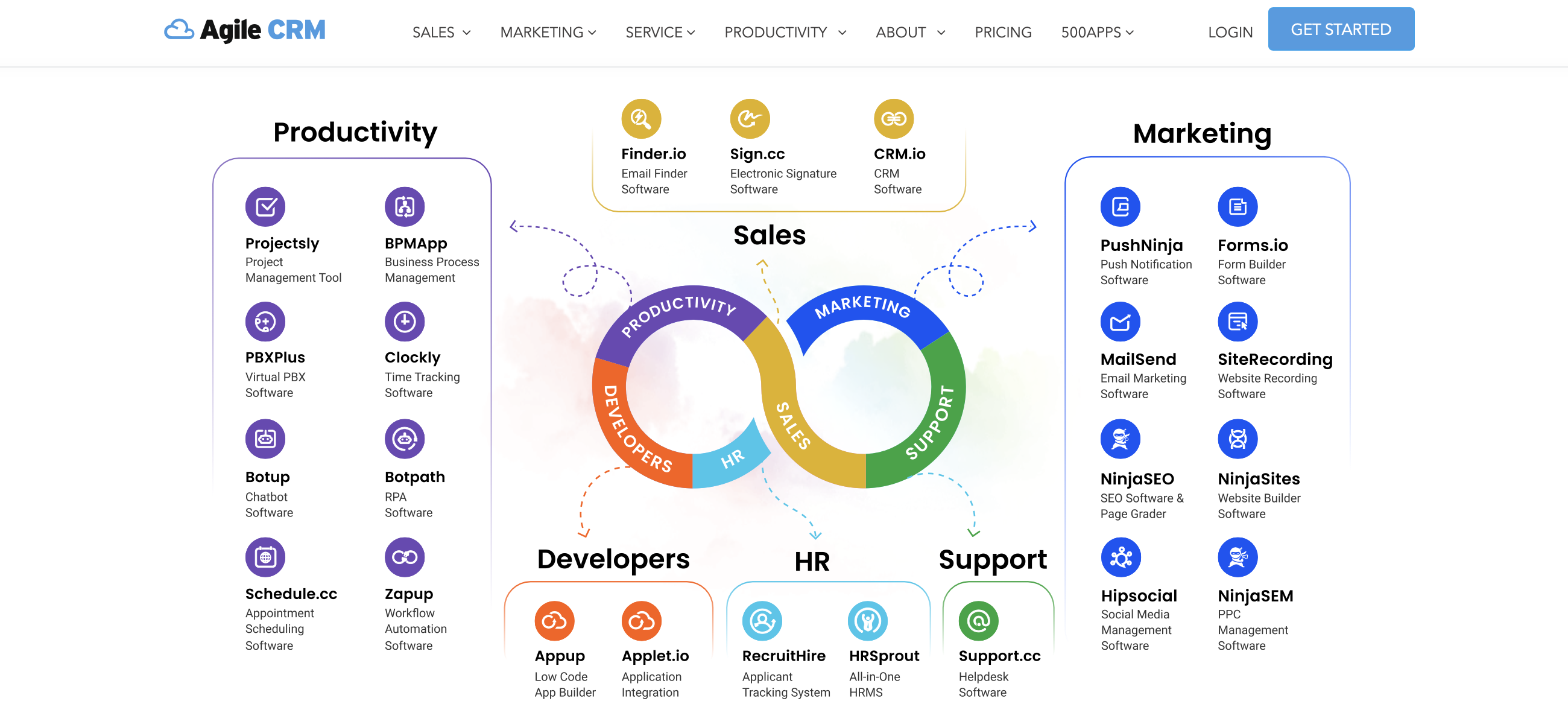
Headquartered in Dallas, Texas with offices in India and the Philippines, the company built its reputation as a budget-friendly all-in-one platform for SMBs. It's now part of the 500apps ecosystem, which bundles 39+ business applications for $14.99/user/month.
The Price-to-Feature Ratio
This is Agile CRM's core selling point, and it's legitimate.
The free plan gives 10 users access to contact management (up to 1,000 contacts), deal tracking, appointment scheduling, lead scoring, and email tracking — features most competitors lock behind paid tiers.
Starter at $8.99/user/month (2-year commitment) adds marketing automation, up to 10,000 contacts, and 5,000 branded emails. For teams where every dollar matters, it's hard to find this much functionality at this price.
All-in-One Without the Enterprise Price Tag
Agile CRM combines CRM, marketing automation, help desk, social media management, web analytics, and telephony integrations in a single platform. You get a drag-and-drop campaign builder, landing page creator, web engagement tracking, and a help desk with ticket management and canned responses — all without buying separate subscriptions.
Competing platforms like HubSpot or Salesforce charge significantly more to cover the same ground.
The Development Problem
⚠ Here's the uncomfortable truth: Agile CRM appears to be in maintenance mode. The product changelog shows minimal updates since 2021.
The Android app is defunct, the Chrome extension was deprecated due to Google compliance issues, and the UserVoice feedback portal is shut down. The company's focus has shifted toward 500apps, their broader SaaS suite.
Existing features still work, and support is still active — but if you're evaluating CRMs for the next 3-5 years, the lack of active development is a meaningful risk factor.
The Verdict: Our Assessment
5.8/10 — Agile CRM offers a remarkable amount of functionality for the price, and the free plan is genuinely useful for small teams.
But the signs of stalled development are impossible to ignore. If you need a CRM that's actively improving, adding modern integrations, and investing in its future, Agile CRM isn't it. If you need the most features possible for the least money right now — and you can accept the risks — it still delivers.
Criteria | Score | Verdict |
|---|---|---|
Value for Money | 8/10 | Unmatched feature-to-price ratio, especially the free plan for 10 users with real CRM functionality |
Feature Breadth | 7/10 | CRM, marketing, help desk, telephony, and social in one platform — impressive scope for SMB pricing |
Ease of Use | 5/10 | Functional but dated interface with 30+ tabs to navigate; learning curve steeper than modern alternatives |
Platform Reliability | 4/10 | Core features work, but stalled development, defunct mobile app, and deprecated extensions raise longevity concerns |
Customer Support | 6/10 | Live chat responsive and praised by users; phone support on paid plans only; free plan limited to email |
Integrations | 5/10 | 50+ native connections plus Zapier, but integration limits on lower plans and deprecated extensions reduce value |
Mobile Experience | 2/10 | Android app defunct, iOS limited — essentially no viable mobile CRM experience |
⚠ Trade-offs: You're getting 2019-era features at 2019-era prices — which can be a great deal if those features match your needs today. But the platform isn't evolving, and the longer you invest in Agile CRM's ecosystem, the higher the eventual migration cost when you outgrow it or the platform's limitations force a switch.
✩ Best for: You're a bootstrapped small team that needs CRM, marketing automation, and help desk under one roof for under $15/user/month, you have 10 or fewer users and want a genuinely useful free plan, or you need lead scoring and sales gamification at a price tier where competitors don't offer them.
✗ Skip if: You need a platform with active development and a clear product roadmap, you rely on mobile CRM access, you need modern integrations with current tools, or you're planning to scale past 25-50 users where the limitations compound.
Fit by Business Type
We scored Agile CRM across 13 business types. The sweet spot is very small, budget-constrained teams that need multi-function tools and can tolerate the platform's aging infrastructure.
Strong Fit
✔ Bootstrapped startups under 10 people (8/10) — the free plan is one of the most feature-complete free CRMs available, covering sales, basic marketing, and help desk at zero cost.
✔ Budget-first small businesses 5-15 people (7/10) — Starter at $8.99/user/month delivers marketing automation and 10,000 contacts at a price most competitors can't match.
Moderate Fit
◑ Small B2B sales teams (6/10) — pipeline management and lead scoring are solid, but the inability to customize pipeline stages and the dated interface frustrate daily users.
◑ Solopreneurs needing all-in-one tools (6/10) — impressive feature breadth for one person, but the learning curve across 30+ modules is steep for someone wearing every hat.
◑ Marketing-focused small teams (5/10) — automation builder is powerful for the price, but email limits, lack of modern template design, and no A/B testing below Regular plan restrict serious marketing use.
Poor Fit
✗ Growing teams 25+ people (3/10) — contact caps, integration limits, and lack of development create friction that compounds with team size and process complexity.
✗ Mobile-dependent sales teams (2/10) — with a defunct Android app and limited iOS functionality, field reps have essentially no mobile CRM access.
✗ Enterprise or mid-market organizations (2/10) — insufficient reporting depth, limited customization, and platform longevity concerns make this a non-starter for serious operations.
✗ Teams planning 3-5 year CRM investment (3/10) — the stalled development means your CRM won't grow with you, making eventual migration almost certain.
What Users Say: Reviews & Verified Experiences
User ratings: 4.0/5 on G2 (approximately 355 reviews), 4.1/5 on Capterra (approximately 524 reviews across platforms), and mixed on Trustpilot (approximately 1,773 reviews under the 500apps brand — reflecting both Agile CRM and the broader suite). The Trustpilot profile includes significant billing and cancellation complaints.
What Users Love
✩ Feature-to-price ratio: The most consistent praise across all platforms. Users repeatedly call it the best value CRM they've found, with multiple reviewers noting they switched from HubSpot specifically because Agile delivers comparable features at a fraction of the cost (G2, Capterra, GetApp).
✩ Marketing automation at budget pricing: The drag-and-drop campaign builder gets strong praise for making multi-step automation accessible to small teams without marketing ops expertise. Facebook lead ad integration and automated sequences are frequently highlighted (Capterra).
✩ Live chat support quality: When users reach support, the experience is generally positive. Chat agents are described as responsive, patient, and willing to help troubleshoot beyond standard requests. Several Trustpilot reviews specifically praise individual support reps (Trustpilot, Capterra).
✩ Consolidation value: Long-term users describe Agile CRM as the foundation of every department — combining databases, interaction logs, and process tracking that would otherwise require multiple subscriptions (Capterra).
Common Complaints
✗ Development stagnation: The most alarming feedback. A detailed G2 review documents no new features since 2021, defunct Android app, deprecated Chrome extension, and a shut-down feedback portal. The reviewer concludes they don't recommend Agile unless the company turns around (G2).
✗ Billing and cancellation nightmares: Multiple Trustpilot reviews describe continued billing after cancellation requests, difficulty reaching someone to process downgrades, and unauthorized charges. One user reported being charged nearly £2,000 after confirming cancellation via email (Trustpilot).
✗ Outdated interface: The UI is consistently described as needing a facelift. Navigating 30+ tabs and modules feels overwhelming, and the visual design hasn't been updated in years (G2, Capterra).
✗ Feature-gating frustrations: Third-party integrations like Twilio, Twitter, and Mandrill are locked to the most expensive plan. Monthly pricing is roughly double the annual rate. Users feel pushed toward expensive tiers for functionality they expected at the advertised price (GetApp).
✗ Glitches and performance: Slow loading times, automation glitches, and integration reliability issues surface regularly. Not dealbreakers for occasional users but frustrating for teams relying on the platform daily (Capterra, G2).
Review Pattern Analysis
The review pattern tells a clear story: older reviews (2018-2021) are overwhelmingly positive, praising Agile CRM as a hidden gem. Recent reviews (2023-2026) increasingly raise red flags about abandoned development, billing issues, and the push toward 500apps.
The platform's ratings haven't collapsed because the core features still work — but the trajectory is concerning for anyone evaluating a long-term CRM relationship.
What Agile CRM Users Typically Achieve
You'll Get CRM, Marketing, and Support Without Multiple Subscriptions
The immediate win is consolidation. Teams that were juggling a separate CRM, email marketing tool, and help desk platform can collapse everything into one system.
For a 10-person team on the free plan, that's a $0 monthly investment covering functionality that would cost hundreds on competing platforms. Even on Starter at $8.99/user, you're paying a fraction of what most all-in-one platforms charge.
You'll Automate Lead Follow-Up on a Starter Budget
The marketing automation builder — available from Starter onward — lets you set up multi-step email sequences, lead scoring rules, and behavior-based triggers without enterprise pricing.
Small teams that previously handled follow-ups manually can automate nurture campaigns, appointment reminders, and deal stage notifications. This is where Agile CRM punches well above its weight class.
Your Sales Team Gets Gamification That Actually Motivates
The leaderboard feature comparing reps on calls, deals closed, and revenue generated is a distinctive feature you won't find at this price point elsewhere. For competitive sales cultures with small teams, it creates visibility and friendly competition without bolting on a separate tool.
Where You'll Hit Ceilings
The contact caps hit first — 1,000 on Free, 10,000 on Starter. Once you outgrow those, you're jumping to Regular at $29.99/user/month, which is less competitive against alternatives that offer unlimited contacts. The inability to customize pipeline stage names frustrates teams with non-standard sales processes.
Email limits restrict marketing-heavy teams. And the moment you need reliable mobile access, modern integrations, or confidence that the platform will still be receiving updates next year, Agile CRM's value proposition weakens significantly.
Here's what works: treat Agile CRM as a high-value starting point, not a forever platform. Use it to establish your sales process, build your contact database, and learn what automation workflows matter to your business.
When you outgrow it — and you likely will — you'll migrate to a more mature platform with much clearer requirements than if you'd started there.
3 Critical Mistakes to Avoid
Mistake #1: Committing to a 2-Year Contract for the Lowest Price
Agile CRM's most attractive pricing — Starter at $8.99/user/month — requires a 2-year billing commitment. The monthly rate is nearly double at $14.99. Teams lock into a 24-month contract to save money, then discover within the first few months that the platform's limitations or stagnation concerns make them want to switch.
But they're stuck paying for a CRM they've already mentally moved on from.
⚠ The Fix: Start with the free plan for up to 10 users. Spend at least 2-3 months using it in production before committing to any paid plan. If you do upgrade, start with annual billing ($9.99/user/month) as a middle ground — the savings versus monthly are still significant without locking you in for two years on a platform with uncertain development trajectory.
Mistake #2: Assuming the Free Plan Represents the Full Platform
The free plan is genuinely useful but heavily restricted: 1,000 contacts, limited automation nodes, no A/B testing, no third-party integrations, email support only (no phone), and branded emails.
Teams build their entire workflow on the free plan, then discover that the features they actually need — marketing automation, integrations, unbranded emails — require Starter or higher. The upgrade path brings sticker shock because the free-to-paid jump changes the cost structure entirely.
⚠ The Fix: Map your actual requirements before building on the free plan. If you need marketing automation, more than 1,000 contacts, or any third-party integrations, you're on a paid plan from day one. Use the free plan as an evaluation tool, not your production environment, unless your team truly fits within its constraints.
Mistake #3: Ignoring the Development Stagnation When Planning Long-Term
A CRM is infrastructure — it touches your sales process, customer data, marketing workflows, and support operations. Teams choose Agile CRM for the price, invest months configuring pipelines and automation, import their entire contact database, train their team — then realize 12-18 months later that the platform isn't keeping pace with their needs or the market.
The Chrome extension you relied on is deprecated. The mobile app your field reps needed is defunct. The integration with a new tool you adopted doesn't exist and never will.
⚠ The Fix: Go in with eyes open. Agile CRM is a strong short-to-medium term solution for budget-constrained teams. But build your workflows with portability in mind — keep your contact data clean and exportable, document your automation logic separately, and plan for a migration timeline within 2-3 years. The savings you capture now can fund a smoother transition later to a platform with active development.
Frequently asked questions
Is Agile CRM still being developed?
This is the biggest question mark. The product changelog shows minimal updates since approximately 2021. The Android app is defunct, the Chrome extension was deprecated, and the UserVoice feedback portal was shut down. The company's focus appears to have shifted toward 500apps, their broader SaaS suite. Existing features still function and support remains active, but there's no visible evidence of meaningful new development. Agile CRM's own responses to these concerns are vague and non-committal.
Is the Agile CRM free plan worth using?
Yes, with constraints. The free plan supports up to 10 users with contact management (1,000 contacts), deal tracking, lead scoring, appointment scheduling, and email tracking. That's more than most free CRM tiers offer. The limitations are real though: no marketing automation, no third-party integrations, email-only support, and branded emails. It works well as an evaluation tool or for very small teams with simple needs.
What's the relationship between Agile CRM and 500apps?
Both products were created by Manohar Chapalamadugu. 500apps is a broader SaaS suite of 39+ business applications priced at $14.99/user/month. Agile CRM is the CRM product within that ecosystem. Trustpilot reviews for Agile CRM appear under the 500apps brand. Some users report being pushed toward 500apps when contacting Agile CRM support, suggesting the parent company's focus has shifted to the broader suite.
How does Agile CRM compare to HubSpot free?
Agile CRM's free plan offers more users (10 vs. HubSpot's unlimited but feature-limited) and includes lead scoring, appointment scheduling, and deal tracking that HubSpot reserves for paid plans. However, HubSpot is actively developed with regular updates, has a modern interface, better mobile apps, and a far larger integration ecosystem. For long-term investment, HubSpot is the safer bet. For maximum free features right now, Agile CRM offers more.
Can I cancel my Agile CRM subscription easily?
This is a documented pain point. Multiple Trustpilot reviews report difficulty cancelling subscriptions, continued billing after cancellation requests, and trouble reaching someone to process changes. If you subscribe to a paid plan, document everything in writing and confirm cancellation explicitly. Monitor your billing statements after cancellation to ensure charges stop.
What are the email sending limits?
Email limits vary by plan: Free gets 1,000 emails/month, Starter gets 5,000, Regular gets 25,000, and Enterprise gets 50,000. You can purchase additional email add-on packages that last one month from purchase. These limits apply to marketing emails sent through Agile CRM's campaign tools. Transactional emails and one-to-one emails from your connected inbox don't count against these limits.