Is Klaviyo Right for You?
If you run a Shopify store doing $50K+/month, you can use Klaviyo's predictive analytics and behavioral flows to generate 30%+ of your revenue from email alone. But if you're a service-based business, you'll pay Klaviyo prices for features built entirely around product sales you'll never use.
⚠ Main limitation: Pricing escalates quickly as your contact list grows. Klaviyo switched to active-profile billing in February 2025, meaning you pay for every contact whether you email them or not. The free plan is extremely restrictive at 250 contacts, and there's a real learning curve before you're using the platform at even half its capability.
✔ Get it if: You run an ecommerce store and want the deepest behavioral data, predictive analytics, and Shopify integration available. You're comfortable investing time to learn the platform.
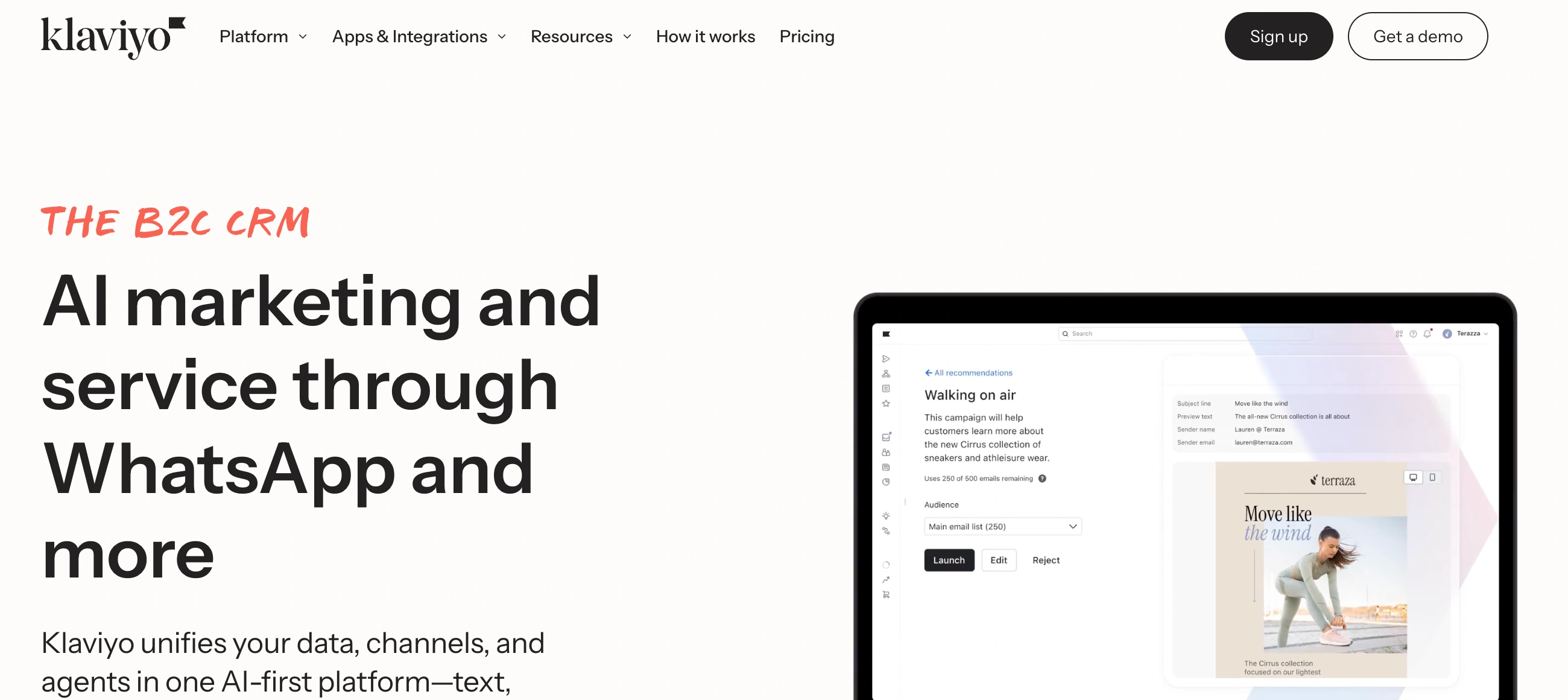
An email and SMS marketing platform built specifically for ecommerce. Klaviyo doesn't just send emails — it builds unified customer profiles from every click, browse, and purchase so your campaigns respond to actual shopping behavior.
Shopify and WooCommerce stores that want predictive analytics, behavioral segmentation, and revenue-attributed reporting.
You're not selling products online, you're budget-sensitive with a growing list, or you just need to send newsletters without complex automation.
Why Klaviyo?
Most email platforms treat your store data as an afterthought. Klaviyo was built around it.
Where other tools are list-based (you have subscribers and you email them), Klaviyo is database-based — it builds a profile for every visitor tracking what they clicked, viewed, carted, and bought. That difference matters when you want to send targeted campaigns that actually convert.
Predictive Analytics That Drive Decisions
Klaviyo's AI calculates predicted customer lifetime value, expected next order date, and churn risk for every profile.
You can segment by these predictions — sending retention offers to high-value customers showing churn signals, or ramping up upselling to profiles with high predicted CLV. This isn't a gimmick feature buried in settings; it's central to how the platform works.
Ecommerce Integration Runs Deep
The Shopify connection goes beyond syncing contacts. Every product view, cart action, and purchase flows into Klaviyo automatically, powering dynamic product recommendations and behavioral triggers in real time.
Shopify owns 11.2% of Klaviyo, which helps explain why the integration is tighter than anything competitors offer. WooCommerce, BigCommerce, and Magento connect natively too, though Shopify users consistently report the smoothest experience.
Revenue Attribution You Can Actually Use
Where most platforms show opens and clicks, Klaviyo shows revenue per recipient and flow-generated revenue tied directly to your store data. You see which emails drive actual purchases, not just engagement. For stores making decisions about where to invest marketing budget, this reporting clarity is worth the premium alone.
The Verdict: Our Assessment
9.0/10 — Klaviyo is the ecommerce email marketing benchmark. Predictive analytics, behavioral segmentation, and revenue attribution are best-in-class. But the active-profile pricing model punishes growing lists, the learning curve is real, and non-ecommerce businesses will find half the features irrelevant.
Criteria | Score | Verdict |
|---|---|---|
Ecommerce Integration | 10/10 | Shopify connection unmatched; real-time behavioral data and product syncing |
Automation Power | 10/10 | Visual flow builder with predictive conditions; 80+ templates; rivals enterprise platforms |
Segmentation | 10/10 | Database-level profiles; predictive CLV, churn risk, and next order date segmentation |
Analytics | 10/10 | Revenue per recipient, flow-generated revenue, deliverability hub with real-time scoring |
Template Library | 9/10 | 350+ email templates with strong design quality; 80+ flow templates |
Ease of Use | 7/10 | Clean interface; basics accessible; advanced features need 4-6 weeks of learning |
Value for Money | 6/10 | Reasonable under 5K contacts; costs climb fast beyond that; no annual discount |
Multi-Channel | 8/10 | Email, SMS, WhatsApp, RCS, push — all unified; SMS credits add to cost |
Support Quality | 7/10 | 24/7 chat and email on paid plans; no phone support; Academy is excellent |
Free Plan | 4/10 | 250 contacts and 500 emails is extremely restrictive; support ends at 60 days |
Non-Ecommerce Fit | 4/10 | Features heavily ecommerce-focused; SaaS, B2B, and service businesses underserved |
Pricing Transparency | 6/10 | Active-profile billing; auto-upgrades; 90-day suppression lock; costs hard to predict |
⚠ Trade-offs: The February 2025 switch to active-profile billing caught many existing users off guard — you now pay for contacts whether you email them or not. Auto-upgrades happen when you cross profile thresholds unless you manually enable auto-downgrade. The 90-day suppression lock means once you suppress a contact, you can't unsuppress them for three months. And if your monthly spend exceeds $10,000, you're required to join Klaviyo One at a 20% surcharge.
Fit by Business Type
Strong fit (8-10)
✔ eCommerce Store (10/10) — This is what Klaviyo was built for; deep Shopify/WooCommerce integration, behavioral triggers, predictive analytics, and revenue attribution are unmatched.
✔ Mid-Sized eCommerce 10-50 (9/10) — Automation complexity scales well with team size; dedicated marketing person can fully leverage the platform.
✔ DTC Brand (9/10) — Predictive CLV, personalized product recommendations, and multi-channel messaging built specifically for direct-to-consumer lifecycle marketing.
✔ Subscription Business (8/10) — Automated renewal reminders, churn prediction, and upsell flows reduce subscriber churn effectively.
Moderate fit (5-7)
◑ Small Business 2-10 (7/10) — Powerful but the learning curve and pricing growth require a marketing-focused team member.
◑ Agency (7/10) — Strong platform to build client campaigns on; lacks white-label and multi-client management features.
◑ Solo Creator/Freelancer (6/10) — Free plan is too restrictive and pricing jumps quickly; better served by Kit, MailerLite, or Brevo.
◑ SaaS/Tech (5/10) — Strong automation engine but features assume product-based selling; event triggers and CRM depth fall behind ActiveCampaign.
◑ B2B Services (5/10) — CRM capabilities are shallow for complex sales cycles; better served by ActiveCampaign or HubSpot.
◑ Nonprofit (5/10) — No meaningful nonprofit discount; ecommerce focus makes most features irrelevant.
Poor fit (1-4)
✗ Budget-Conscious (4/10) — Active-profile billing with no annual discount makes this one of the most expensive options as your list grows; Brevo, Moosend, or MailerLite offer far better value.
✗ Content Creator (4/10) — No monetization tools, no recommendation network, no paid newsletter features; Kit or Beehiiv are purpose-built.
✗ Local Business (3/10) — Overkill for appointment reminders and promotions; Constant Contact or Brevo covers your needs for a fraction of the cost.
✗ Enterprise 50+ (5/10) — Klaviyo One exists but mandatory 20% surcharge and lack of phone support make it hard to justify against Salesforce Marketing Cloud or HubSpot.
✗ ✩ Best for: Shopify and WooCommerce stores doing meaningful revenue that want the deepest ecommerce data integration, predictive analytics, and revenue-attributed reporting available in the category.
✗ Skip if: You're not selling products online, you're sensitive to costs as your list grows, you want simple newsletter sending, or you need phone support.
What Users Say: Reviews & Verified Experiences
User ratings: 4.6/5 on G2 (1,100+ reviews), 4.6/5 on Capterra (2,600+ reviews), ~3.0/5 on Trustpilot (330+ reviews), 4.5/5 on Shopify App Store (2,570+ reviews).
What Users Love
✩ Segmentation Power: "I can create highly targeted, agent-specific emails with dynamic content and custom properties, without running into limitations," reports a verified Health & Wellness ecommerce manager on Capterra. Multiple G2 reviewers highlight segmentation as Klaviyo's standout advantage over every competitor they've tried.
✩ Shopify Integration: "I find Klaviyo incredibly flexible and it integrates really well into our other systems, especially with Shopify," notes Brandon L., Digital Marketing Manager on G2. Users consistently describe the Shopify connection as seamless with data syncing in minutes.
✩ Revenue Tracking: "It provides information needed for the business to make data-driven decisions," according to one long-term ecommerce user on G2. Revenue per email and flow-generated revenue metrics get frequent praise for connecting marketing activity to actual sales.
✩ Automation Depth: "The flows are very powerful and everything is so easy to use. They keep releasing updates too so it's very good value for money," says Joseph E., ecommerce IT Manager on Capterra who has used Klaviyo for 2+ years.
✩ Template Quality: Users praise the 350+ templates and drag-and-drop builder for producing professional-looking emails without design skills or coding knowledge.
Common Complaints
⚠ Pricing Escalation: "We didn't appreciate the drastic price increase last year. It's a bit abusive even though the service is great," writes Raphael F., Head of Ecommerce (Cosmetics) on Capterra. The February 2025 billing switch from email volume to active profiles is the most common complaint across all platforms.
⚠ Learning Curve: "My overall experience has been difficult to where I've used it and gave up on understanding it," admits one small retail owner on Capterra. Multiple reviewers note that advanced segmentation and flow building require genuine expertise.
⚠ Support Gaps: "No phone support...live chat support is very confusing and they refer to self help a lot. You have to have a lot of patience," reports one Capterra reviewer. Free plan users lose even email support after 60 days.
⚠ Editor Limitations: "The email editing portion of Klaviyo isn't the greatest, copying and pasting text can be a little bit of an issue," flags one G2 reviewer. Several users mention the editor can feel glitchy, particularly with text formatting.
⚠ Trustpilot Disconnect: Trustpilot reviews skew heavily negative (~3.0/5) compared to G2 and Capterra. Common complaints include refund difficulties, account issues, and deliverability drops during peak sending like Black Friday. Klaviyo themselves acknowledge that G2 and TrustRadius provide more balanced platform reviews.
What Klaviyo Users Typically Achieve
Your Revenue Per Email Goes Up
When you shift from batch-and-blast newsletters to behavior-triggered flows, you're sending fewer emails to more receptive people. Predictive segments let you target customers showing buying signals before they even hit your site.
The difference between "here's our weekly sale" and "here's the exact product you browsed yesterday, now 15% off" shows up directly in your revenue dashboard.
Abandoned Carts Actually Convert
Cart recovery flows that trigger based on actual cart contents, cart value thresholds, and customer purchase history recover sales that generic reminder emails miss.
If you layer SMS follow-ups into the same sequence, you're reaching customers on whichever channel they respond to. The automation runs continuously while you focus on other things.
Your Customer Data Becomes Actionable
If you've been sitting on purchase history and browsing data without using it, Klaviyo turns that data into segments you can target immediately. Predicted churn risk lets you send retention offers before customers disappear.
Predicted CLV helps you identify your highest-value segments so you can invest in keeping them. This shifts your marketing from guesswork to informed decisions.
Multi-Channel Stops Being a Separate Project
If you've been managing email in one tool and SMS in another, consolidating into Klaviyo eliminates duplicated workflows and inconsistent messaging. The same behavioral triggers, the same customer profiles, the same reporting — across email, SMS, WhatsApp, and push. Your campaigns feel coordinated instead of fragmented.
Your Email Marketing Becomes Measurable
If you've been tracking opens and clicks without knowing what actually drives revenue, Klaviyo's attribution model connects every email to store transactions.
You stop guessing which campaigns work and start allocating budget based on actual performance data. For stores making real marketing investments, this visibility changes how you think about email entirely.
3 Critical Mistakes to Avoid
Mistake #1: Ignoring Active Profile Count as Your List Grows
You launch your store, add Klaviyo, and signups roll in through checkout and pop-up forms. Six months later your list has tripled — and so has your bill.
Klaviyo auto-upgrades your plan when you cross profile thresholds, and the billing is based on active profiles whether you email them or not. If you're not regularly suppressing unengaged contacts, you're paying for people who stopped opening your emails months ago.
⚠ Fix it: Check your billable profile count monthly. Set up re-engagement flows to win back inactive subscribers, then suppress anyone who hasn't engaged in 90+ days. Be aware of the 90-day suppression lock — once you suppress a profile, you can't unsuppress it for three months. Budget for list growth at 2-3x your current rate if signups are steady.
Mistake #2: Using Klaviyo Like a Basic Newsletter Tool
You sign up, build a template, and send the same weekly broadcast to your entire list. You could do that with Mailchimp for less money.
Klaviyo's value is in behavioral automation, predictive segmentation, and personalized product recommendations — features that require setup time but generate the revenue that justifies the premium pricing. If you're not building flows and segments, you're overpaying for a tool you're underusing.
⚠ Fix it: Start with the three highest-impact flows: welcome series, abandoned cart, and post-purchase. Use the pre-built templates — they're based on patterns that work. Then add browse abandonment and winback flows. Invest 4-6 weeks learning the platform through Klaviyo Academy before judging whether it's worth the cost.
Mistake #3: Skipping List Hygiene Before Importing
You migrate from another platform and import your full contact list — including years of inactive subscribers, bounced addresses, and people who forgot they signed up.
Your deliverability tanks immediately because Klaviyo's infrastructure treats sender reputation seriously. Your first campaigns land in spam folders, and digging out of that hole takes weeks of careful re-warming.
⚠ Fix it: Clean your list before importing. Remove hard bounces, filter out contacts inactive for 6+ months, and verify email addresses through a validation service. Start by sending to your most engaged segment first and gradually expand. Klaviyo's Deliverability Hub scores your sender health — use it from day one to catch problems early.
Frequently asked questions
How much does Klaviyo cost?
Free plan covers 250 active profiles and 500 emails/month. Email plan starts at $20/month for up to 500 profiles with a 10x send cap (5,000 emails). Email + SMS starts at $35/month with 1,250 SMS credits. Costs scale with active profile count — roughly $175/month at 10,000 contacts and $375/month at 20,000. Spending above $10,000/month triggers mandatory Klaviyo One enrollment with a 20% surcharge. No annual billing discounts available.
Does Klaviyo integrate with my ecommerce platform?
Shopify integration is the deepest — install the app, connect in minutes, and all historical data syncs automatically. WooCommerce, BigCommerce, and Magento also connect natively, though Shopify users consistently report the smoothest experience. Beyond ecommerce, Klaviyo offers 350+ integrations spanning CRMs, loyalty programs, review platforms, helpdesks, and advertising tools.
Is Klaviyo hard to learn?
The basics are accessible — building a campaign and setting up a simple flow takes no coding and minimal experience. But advanced features like predictive segmentation, conditional branching, and multi-channel flow coordination genuinely require expertise. Plan on 4-6 weeks before you're using the platform at half its capability. Klaviyo Academy's structured courses help significantly and are among the best vendor-provided training in the category.
How does Klaviyo compare to Mailchimp?
Klaviyo wins on ecommerce depth, segmentation, predictive analytics, and revenue attribution. Mailchimp wins on simplicity, broader use-case flexibility, and lower entry pricing. Both now start at $20/month for 500 contacts, but Klaviyo's costs rise faster at scale. If you're running an online store and want data-driven automation, Klaviyo is the stronger choice. If you need a simpler, general-purpose email tool, Mailchimp makes more sense.
What support does Klaviyo offer?
Paid plans get 24/7 email support and live chat. Email + SMS subscribers also get access to a Growth success team. Free plan users receive email support for the first 60 days only, then it's community forums and self-service resources. No phone support on any plan. Klaviyo Academy provides excellent structured training with certifications.
Can I use Klaviyo if I'm not an ecommerce store?
You can, but you'll find a lot of features irrelevant. Abandoned cart flows, product recommendations, predictive purchase timelines, and catalog syncing assume product-based selling. SaaS companies, B2B services, and content creators will be paying for functionality they don't use. For non-ecommerce needs, ActiveCampaign, Brevo, or Kit typically offer better fit at lower cost.