Is GoDaddy Hosting Right for You?
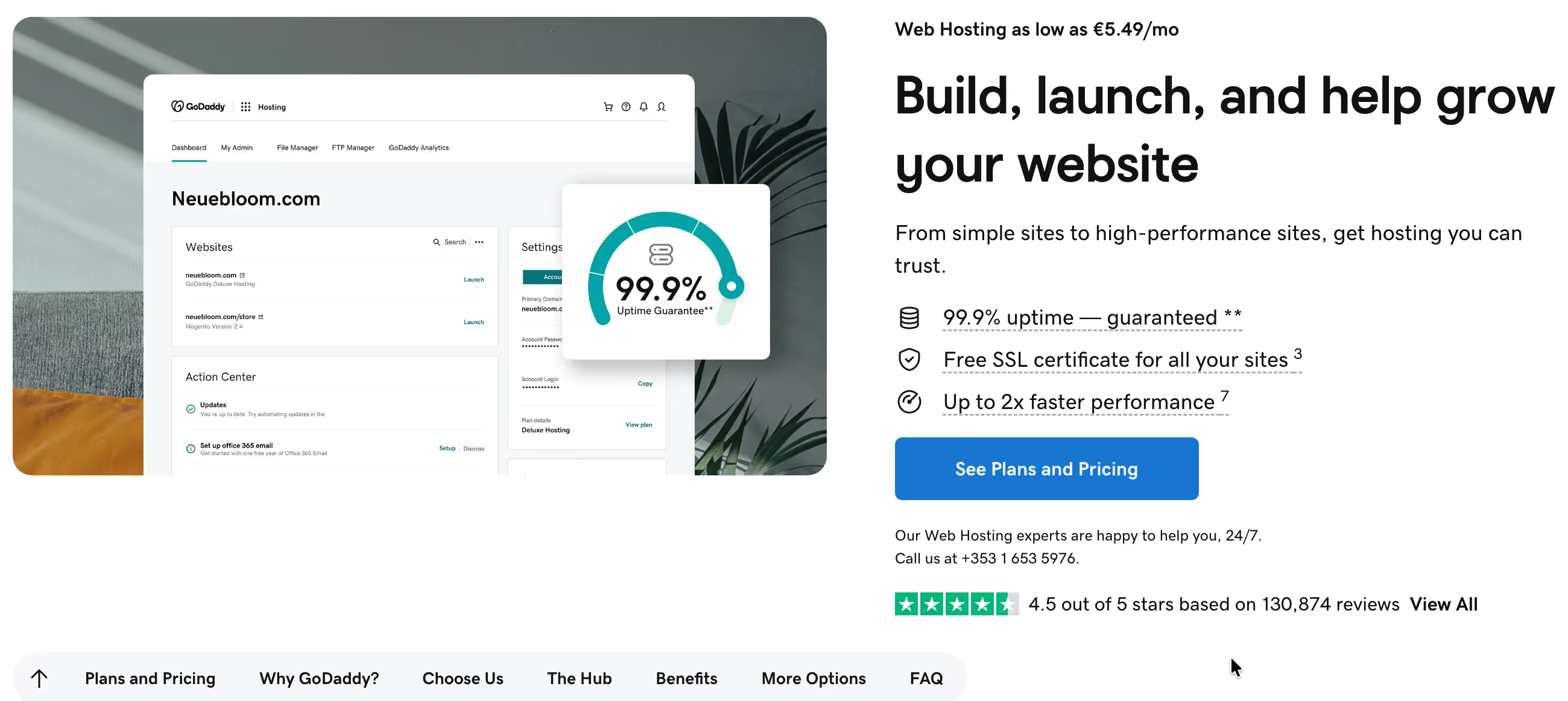
A ZDNet test found GoDaddy achieving 100% uptime with server responses averaging 180ms and page loads under one second — crowning it their top pick for small businesses in 2026.
On the other side, the FTC finalized a consent order against GoDaddy in May 2025 for "unreasonable security practices" that led to multiple data breaches between 2019 and 2022, including one that compromised 1.2 million Managed WordPress customer accounts and another that exposed 28,000 customer SSH credentials and approximately 1,000 credit card numbers.
We scored it 7.2/10: the Airo AI suite genuinely simplifies site creation, the managed WordPress plans are competent, uptime performance in recent tests is strong, and 24/7 telephone support remains valuable.
But GoDaddy is more expensive than competitors offering more features, the FTC security order casts a shadow over data protection trust, the upselling is among the most aggressive in hosting, shared plans lack features that competitors include free, and the renewal pricing more than doubles. It's a host you choose because you already trust the name — not because you compared the specs.
⚠ Main limitation: The FTC finalized a security order against GoDaddy in May 2025 for failing to implement reasonable security measures since 2018 — including multi-factor authentication, threat monitoring, and secure API connections. Multiple data breaches between 2019-2022 compromised customer data. GoDaddy is required to establish a comprehensive security program and submit to independent biennial security reviews. This history should factor into your decision, particularly if your site handles sensitive customer data.
✔ Get it if: You want domain + hosting + email from one familiar brand, you value phone support, you're building a simple site and don't need LiteSpeed performance, or you want the Airo AI tools for quick site generation.
Full-service hosting from the world's largest domain registrar. Also: High Performance shared plans at premium pricing. No dedicated servers. Data centers in US and Europe.
You already use GoDaddy for domains and want hosting from the same provider. You're not technical and want everything — domain, hosting, email, builder — from one recognizable company.
You want the best value per dollar (Hostinger, IONOS, and HostArmada offer more for less), you're concerned about the security breach history, you dislike aggressive upselling, you need LiteSpeed or modern server technology…
Why GoDaddy?
Let's be honest about why people choose GoDaddy: brand recognition. Twenty years of marketing, Super Bowl ads, and being the default suggestion when someone says "I need a website" has made GoDaddy synonymous with "getting online."
The company serves 20+ million customers worldwide, and for many small business owners, GoDaddy is the only hosting company they can name. That familiarity has real value — it reduces the anxiety of choosing a provider, and the all-in-one platform means you don't need to coordinate between a domain registrar, hosting provider, and email service.
GoDaddy Airo: AI That Actually Helps
GoDaddy Airo is the company's agentic AI suite, introduced in late 2025. It goes beyond a simple website builder — give it prompts about your business and it generates a domain name suggestion, logo, complete website draft, product descriptions, social media posts, and even helps with business paperwork.
The managed WordPress version builds a full site from simple prompts in under a minute, and you refine everything in the WordPress editor. For non-technical business owners who feel overwhelmed by the steps between "I have a business idea" and "I have a website," Airo collapses that journey significantly. It's GoDaddy's strongest competitive feature in 2026.
The All-in-One Ecosystem
Domain registration, hosting, email, website builder, online store, marketing tools, social media management, and business phone — all from one dashboard, one login, one bill, one support team.
For small businesses that don't have IT staff and want one company handling everything digital, this consolidation is genuinely convenient. The ecosystem creates vendor lock-in, but for users who value simplicity over flexibility, that's a trade-off they're willing to make.
Phone Support That Answers
24/7 phone and chat support on all plans. For small business owners who need to talk through a problem with a real person — not type into a chat window while juggling phone calls — GoDaddy's phone support is a genuine differentiator.
Support quality reviews are mixed (some excellent, some scripted-feeling), but the channel exists and typically connects quickly. In an industry where budget hosts have eliminated phone support entirely, GoDaddy maintains it.
The Verdict: Our Assessment
7.2/10 — GoDaddy is the hosting provider you choose when the brand name matters more than the spec sheet. The all-in-one platform genuinely simplifies digital operations for non-technical business owners. The Airo AI tools are impressive. Phone support is available. Recent performance tests show strong uptime and acceptable speed.
But the pricing is higher than competitors for comparable features, the security breach history culminating in an FTC order is concerning, the upselling is relentless, and critical features like Site Security and daily backups cost extra on plans from a provider already under regulatory scrutiny for inadequate security. In 2026, familiarity with a brand name isn't enough — especially when Hostinger, IONOS, and HostArmada deliver more features, better value, and comparable or better performance at lower prices.
Criteria | Score | Verdict |
|---|---|---|
Brand & Ecosystem | 9/10 | World's largest domain registrar with a full digital ecosystem — domain, hosting, email, builder, marketing from one provider |
AI Tools | 8/10 | AI suite generates sites, logos, content, and social posts from prompts — the most comprehensive AI business toolkit in hosting |
Support | 7/10 | 24/7 telephone and chat on all plans — call-in support connects quickly though quality varies and upselling occurs during calls |
Performance | 6/10 | Recent tests show strong uptime and acceptable speed, but no LiteSpeed and average performance under high concurrent load |
Security Trust | 3/10 | FTC consent order for security failures (2025), multi-year breach history (2019-2022), and security features cost extra on most plans |
Value | 4/10 | More expensive than competitors for comparable features — add-ons, renewal pricing, and SSL costs inflate total ownership significantly |
Transparency | 3/10 | Checkout prices differ from advertised rates, auto-added products, aggressive upselling, and security marketed as "award-winning" despite FTC action |
⚠ Trade-offs: Maximum brand familiarity and ecosystem convenience at a premium price, with security trust concerns that competitors don't carry.
✔ Best for: Non-technical business owners who want everything from one familiar brand. Users who already have domains at GoDaddy and want hosting there too. Simple small business sites where convenience outweighs value optimization.
⚠ Skip if: You compare features per dollar (competitors win). You're concerned about the documented security history. You need LiteSpeed performance. You dislike being upsold. You're running a site with sensitive customer data.
Fit by Business Type
Strongest for non-technical small businesses wanting brand familiarity; weakest for security-sensitive and value-conscious users.
Strong Fit
✔ Non-technical small business owners (7/10) — the all-in-one ecosystem and Airo AI tools simplify getting online for people who don't want to learn hosting terminology.
✔ Existing GoDaddy domain customers (7/10) — consolidating hosting with your domain registrar eliminates DNS configuration and cross-provider management.
Moderate Fit
◑ WordPress bloggers (5/10) — managed WordPress plans are competent but don't match Hostinger's speed or SiteGround's WordPress optimization at similar pricing.
◑ Small online stores (5/10) — hosting works for basic WooCommerce but the pricing structure makes dedicated e-commerce hosting more expensive than competitors.
◑ Freelancers with client sites (5/10) — the ecosystem handles multiple projects but the per-site economics don't compete with hosts offering unlimited sites at lower prices.
Poor Fit
✗ Security-conscious businesses (2/10) — FTC consent order, multi-year breach history, and security features behind paywalls create an unacceptable risk profile for sensitive data.
✗ Value-optimizing users (3/10) — at every price point, competitors offer more features, better security inclusion, and lower renewal rates for comparable hosting.
✗ Performance-first developers (3/10) — no LiteSpeed, no Redis on shared plans, and average performance benchmarks make GoDaddy unsuitable for speed-critical projects.
What Users Say: Reviews & Verified Experiences
User ratings are polarized: decent Trustpilot scores but a toxic Reddit reputation. The split reflects GoDaddy's two user bases — non-technical small business owners who find the ecosystem convenient and rate it well, versus technically informed users who see better options everywhere and rate it poorly.
The volume of reviews (thousands across platforms) makes the pattern statistically meaningful: GoDaddy works for simple sites from users who don't compare, and frustrates users who do.
What Users Love
✩ Brand comfort: "I trust GoDaddy because their products and services are reliable and they have top-tier customer support" represents the loyal customer base. For users who've been with GoDaddy for years, the familiarity and consistency of the platform create comfort that overrides pricing concerns (Trustpilot, ZDNet).
✩ Airo AI tools: The AI site builder earns genuine praise for speed and quality. Users describe generating complete business websites in under a minute. For non-technical owners who dreaded the site-building process, Airo transforms a weekend project into a lunch-break task (independent reviews).
✩ Easy dashboard: The custom dashboard gets positive reviews for clarity and accessibility. "Makes it easy to manage multiple websites and servers, no technical expertise needed" captures the sentiment. Compared to cPanel's density, the management interface feels modern and approachable (ZDNet, AllAboutCookies).
Common Complaints
⚠ Relentless upselling: The most universal complaint. "GoDaddy has so many upsells they have a product catalog." Microsoft 365 auto-added to cart during checkout, dashboard promotions for paid upgrades, and support agents recommending paid services instead of solving problems. One user documented paying upwards of $1,000/year to GoDaddy, mostly from accumulated upsells they didn't realize they'd agreed to (Trustpilot, Reddit, independent reviews).
⚠ Security breach concerns: The FTC consent order is referenced in multiple independent reviews as a reason to hesitate. Users describe malware infections on GoDaddy-hosted sites and being charged $500+ for malware removal services. "They do very little to prevent it" while charging premium prices to fix it creates a perception of profiting from their own security gaps (Trustpilot, independent reviews).
⚠ Expensive for what you get: Reviewers consistently note that GoDaddy charges more for fewer features than competitors. "At this or even a way lower price, it's smarter to get Hostinger or SiteGround with more features, better performance, and adequate security that won't cost you extra" summarizes the value criticism (Gizmodo, Cybernews, independent reviews).
⚠ Vendor lock-in: Users wanting to leave GoDaddy describe complicated domain transfer processes, difficulty exporting data, and an ecosystem designed to make staying easy and leaving hard. The all-in-one convenience becomes all-in-one dependency (Reddit, independent reviews).
What GoDaddy Users Typically Achieve
You'll Get Online Without Learning Hosting Jargon
This is GoDaddy's core value proposition. A restaurant owner, a plumber, a local boutique — someone who needs a website but considers "hosting" a foreign concept — can go to GoDaddy, get a domain, sign up for hosting, and use Airo to generate a complete website without ever understanding what DNS, SSL, or cPanel means. The site works.
The email works. The domain points to the right place. For the millions of small businesses that have been procrastinating on their web presence because it felt too technical, GoDaddy removes that barrier. The question is whether the premium you pay for that simplicity is justified when competitors offer similar ease at lower prices.
Everything Digital Lives in One Place
Domain registration, hosting, email, website builder, online store, SEO tools, social media management, and even business phone services — all from one account. For small business owners who dread managing multiple vendors, this consolidation is genuinely valuable.
One login. One support number. One bill. No coordinating between a registrar, a host, and an email provider. The trade-off is vendor dependency: when everything's at GoDaddy, leaving GoDaddy means moving everything at once.
Where You'll Hit Ceilings
⚠ The cost ceiling becomes visible at renewal. Your $5.99/month hosting becomes $11.99-15.32/month. Your free SSL on Economy renews at $119.99/year. The daily backups you thought were included cost $2.99/month extra. The security features that should be standard cost $5.99-7.99/month extra. Your actual annual hosting cost — with adequate security, backups, and SSL — approaches $300-400/year, where Hostinger's comparable setup costs under $200. The performance ceiling exists for any site expecting significant traffic — no LiteSpeed technology means you're not getting the speed advantages that modern hosts provide. And the trust ceiling: if your business handles customer payment data or personal information, the FTC security order should give you pause about entrusting that data to a provider whose security practices were found "unreasonable" by federal regulators.
💡 If you're committed to GoDaddy, choose the Deluxe shared plan as the minimum (unlimited sites, unlimited storage, unlimited free SSL). Skip the Economy plan — the $119.99/year SSL renewal alone makes it a bad deal. Decline every add-on at checkout; add security and backup products only after evaluating whether you genuinely need GoDaddy's versions or if free WordPress plugins provide equivalent protection.
Consider the managed WordPress plans over standard shared hosting — the Airo integration and managed updates justify the pricing better than the basic shared offering. And honestly evaluate whether brand familiarity is worth the premium: Hostinger offers more features at roughly half the price with better performance benchmarks.
3 Critical Mistakes to Avoid
Mistake #1: Not Removing Auto-Added Products at Checkout
A bakery owner needs a website. They pick GoDaddy's Economy plan at $5.99/month. During checkout, Microsoft 365 email ($5.99/month) is automatically added to their cart. They don't notice — or assume it's part of the hosting. They also agree to SiteLock ($6.99/month) and a premium SSL ($79.99/year) because the checkout flow implies they're necessary.
Their first monthly bill is $18.97/month plus annual SSL charges — over 3x what they expected. They don't discover the extras until they review their credit card statement months later and realize they've been paying for services they didn't knowingly choose.
⚠ The Fix: Before entering payment information, review every line item in the cart. Remove anything that isn't the hosting plan itself. Free SSL is included with all plans (don't buy premium SSL unless you specifically need extended validation). Free email comes with shared hosting (don't add Microsoft 365 unless you need its specific features). You don't need SiteLock on day one — install a free security plugin like Wordfence instead. The hosting plan alone provides everything you need to launch. Add paid services later only if a specific need arises that free alternatives don't address.
Mistake #2: Choosing GoDaddy Because It's the Only Host You've Heard Of
A freelance photographer picks GoDaddy because "that's what everyone uses" and signs up for the Deluxe plan at $7.99/month. After a year, a colleague mentions they're paying $2.99/month for Hostinger's Business plan — which includes daily backups, more storage, LiteSpeed server, and email — all features the photographer is either paying extra for or doesn't have at GoDaddy.
The photographer realizes they're spending approximately $200/year more for equivalent or inferior hosting, purely because they didn't spend 10 minutes comparing alternatives.
⚠ The Fix: Before committing, compare GoDaddy against at least two alternatives on three criteria: total cost at renewal (including all add-ons you'll need), features included in the base price, and independent performance benchmarks. Hostinger consistently costs less with more features. IONOS offers better uptime guarantees with included email. HostArmada includes security on every plan. SiteGround delivers faster WordPress performance. GoDaddy may still win on ecosystem convenience for your specific situation, but make that an informed choice rather than a default one.
Mistake #3: Ignoring the Security History When Handling Customer Data
A small online store launches on GoDaddy's shared hosting, collecting customer names, addresses, and payment information through WooCommerce. The store owner assumes "GoDaddy is huge, so it must be secure." They don't know about the multi-year breach that compromised 1.2 million WordPress customer accounts, or the FTC order finding GoDaddy's security practices "unreasonable" since 2018.
They also don't upgrade to the Site Security suite because it costs extra. Their site operates with basic security on a platform that federal regulators have found inadequate — handling the exact type of customer data that makes breaches consequential.
⚠ The Fix: If your site handles sensitive customer data — payment information, personal details, health records — choose a host with a clean security record and security included on all plans (HostArmada, SiteGround). If you stay with GoDaddy, invest in the Site Security suite regardless of cost, implement your own WordPress security measures (Wordfence or Sucuri), keep regular offsite backups, and monitor your site for unauthorized changes. GoDaddy is implementing the security improvements required by the FTC order, but the track record means trusting their security requires verification rather than assumption.
Frequently asked questions
How much does GoDaddy hosting cost?
Shared hosting intro (36-month): Economy $5.99/month (1 site, 25GB NVMe), Deluxe $7.99 (unlimited sites/storage), Ultimate $12.99 (unlimited + Site Security). Renewal: Economy ~$11.99-15.32, Deluxe ~$16.99, Ultimate ~$21.99. Managed WordPress from $5.99/month. VPS from $8.99. Free domain (year 1), free SSL. Watch for auto-added products at checkout. 30-day money-back guarantee.
Is GoDaddy secure?
GoDaddy is under an FTC consent order (finalized May 2025) for failing to implement reasonable security measures since 2018. Multiple data breaches between 2019-2022 compromised customer data, including 1.2 million Managed WordPress accounts. GoDaddy is required to establish a comprehensive security program with independent biennial audits. Security features like WAF and malware removal cost extra on most plans.
How does GoDaddy compare to Hostinger?
Hostinger is cheaper at both intro and renewal pricing, includes more features in base plans (daily backups, email, LiteSpeed), and benchmarks faster in independent tests. GoDaddy offers the stronger brand, broader ecosystem (domains + marketing + business tools), phone support, and the Airo AI suite. For most users comparing features and value, Hostinger is the better choice. GoDaddy wins on ecosystem convenience and brand familiarity.
Does GoDaddy include email?
Shared hosting includes basic cPanel email (10-unlimited accounts depending on plan). However, Microsoft 365 email is frequently auto-added during checkout as an upsell ($5.99/month per user). Managed WordPress plans handle email separately. The included email is functional for basic needs; professional business email with full features typically requires the Microsoft 365 upgrade.
What is GoDaddy Airo?
GoDaddy Airo is an agentic AI suite that generates domain name suggestions, logos, complete website drafts, product descriptions, social media posts, and business documents from simple prompts. The managed WordPress version builds full sites in under a minute. It's GoDaddy's strongest feature differentiator in 2026 — though the premium Airo plans start at $26.99/month.
Should I use GoDaddy for WooCommerce?
GoDaddy supports WooCommerce through its managed WordPress plans, but competing hosts offer better WooCommerce value. Security features cost extra despite the FTC security concerns, daily backups aren't included on basic plans, and no LiteSpeed technology means slower store performance than competitors. SiteGround, Cloudways, or Hostinger provide better WooCommerce hosting at comparable or lower pricing with included security.