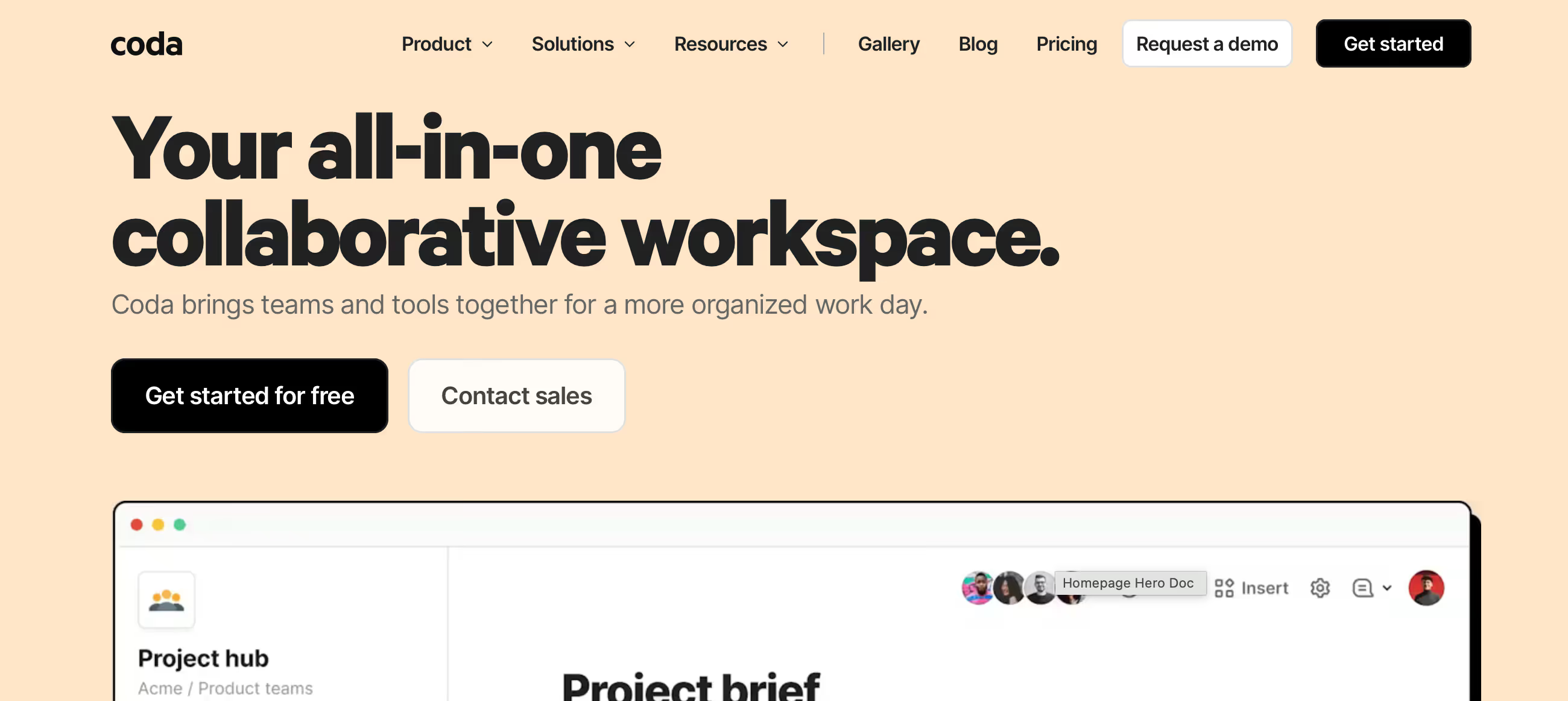
Is Coda Right for You?
An operations manager replaced her team's Asana, Google Sheets, and Slack-based workflows with a single Coda doc — project tracking, meeting notes, OKRs, and automated standup updates all lived in one place, and she cut their monthly tool spend by two-thirds because only three people (the Doc Makers) were billed while 30 editors used it free.
On the other hand, a marketing team adopted Coda expecting Notion-like simplicity and hit a wall when they tried to build anything beyond basic docs — the formula language felt like learning Excel from scratch, complex docs slowed down on mobile, and onboarding the team took three weeks before anyone could build something useful independently.
We scored it 7.8/10: it's the most powerful doc-based workflow platform available, genuinely capable of replacing multiple tools with a single custom-built system.
But "powerful" comes with "complex," and the learning curve means teams need a builder mindset to unlock what makes Coda special. If you have that mindset, nothing else in the category matches what you can create.
⚠ Main limitation: The learning curve is steep — basic editing is simple, but building the powerful systems Coda is designed for requires learning its formula language, table relationships, and automation logic. Training typically takes 2-3 weeks before teams build independently. Complex docs with heavy automations still experience mobile performance issues. And the Doc Maker pricing model, while cost-effective for the right structure, confuses teams where most people need to create docs.
✔ Get it if: You have people who think in systems and want to build custom tools, your team structure fits the Doc Maker model (few builders, many editors), or you're consolidating multiple tools into one workspace.
All-in-one collaborative doc platform — documents, spreadsheets, and apps in one workspace. Only Doc Makers pay — editors and viewers are free on all plans. 800+ Packs (integrations). Coda Brain AI for cross-platform knowledge.
You want to build custom workflows rather than adapt to rigid project management tools. You have a small builder team creating docs for a larger organization (the Doc Maker model saves significantly).
You need a simple plug-and-play project management tool (use Monday.com or Asana), your team won't invest time in learning the formula system (use Notion for simpler docs-plus-databases)…
Why Coda?
Coda was built on a single insight: documents and spreadsheets shouldn't be separate categories of software. A Google Doc is readable and collaborative but can't calculate. A spreadsheet can calculate but is hostile to anyone who doesn't think in cells.
Coda collapsed that spectrum — you write prose, embed a table, connect it to another table with a lookup, add a button that fires a Slack message when clicked, and wrap everything in navigable pages that look like a wiki. It reads like a document and works like an application.
The Maker Mindset
Coda is explicitly designed for people who want to build custom systems rather than adapt to pre-packaged ones. While Monday.com and Asana give you project boards with configured views, Coda gives you building blocks — tables, formulas, buttons, automations, and integrations — that you assemble into whatever your workflow actually needs.
The trade-off is clear: Monday.com works in 10 minutes; Coda takes 3 weeks to learn but builds exactly what you need instead of approximately what you need.
Doc Maker Pricing Is Genuinely Different
Most productivity tools charge per user. Coda charges per Doc Maker — the people who create and structurally edit docs. Everyone else (editors who add rows, update content, interact with buttons) uses it free. A team of 50 where 5 people build docs and 45 people use them pays for 5 seats instead of 50.
One team reported cutting their tool costs to one-sixth of what they were paying Notion. This model rewards organizations with clear builder/user separation — and penalizes teams where everyone needs to create docs.
The 2025-2026 Platform Evolution
HyperTable launched in 2025, eliminating the previous 10,000-row performance ceiling and enabling 500,000+ rows per doc with sub-second filtering. Coda Brain — the AI knowledge layer — now indexes Slack, Google Drive, and Jira directly within docs, providing cross-platform context retrieval.
Two-Way Sync Packs ensure data modified in Coda instantly updates in external systems. These additions moved Coda from "flexible doc tool" to "custom ERP builder" for teams willing to invest in the platform.
The Verdict: Our Assessment
7.8/10 — Coda is the most powerful doc-based platform for teams willing to invest in learning it. The combination of documents, relational databases, automations, and 800+ integrations creates a workspace that genuinely replaces multiple tools. The Doc Maker pricing model can be dramatically cheaper than per-seat competitors when your team structure fits.
But the learning curve is real, the mobile experience lags, and teams that want plug-and-play simplicity will find the investment disproportionate to their needs.
Criteria | Score | Verdict |
|---|---|---|
Workflow Building Power | 10/10 | The most flexible doc-based platform for creating custom tools, trackers, and internal apps without code |
Doc Maker Pricing | 9/10 | Teams with few builders and many editors save dramatically versus per-seat competitors — genuinely different model |
Integration Depth | 9/10 | 800+ Packs with two-way sync make Coda the central hub that connects to your entire toolstack |
AI Capabilities | 8/10 | Coda Brain indexes cross-platform knowledge with strong context retrieval — more useful for workflows than Notion AI |
Learning Curve | 4/10 | 2-3 weeks to build independently; the formula language is powerful but requires genuine investment to learn |
Mobile Experience | 5/10 | Simple docs work fine on mobile; complex docs with automations experience load delays and interface limitations |
⚠ Trade-offs: Maximum building power at the cost of a steep learning curve. Coda rewards investment — teams that commit to learning it build systems nothing else can match. Teams that won't commit get an overcomplicated doc editor.
Fit by Business Type
Strongest for operations-heavy teams building custom workflows; weakest for teams wanting simple, ready-to-use project management.
Strong Fit
✔ Operations and process teams (10/10) — the core use case where custom workflows, automations, and connected data create systems that pre-packaged tools can't replicate.
✔ Product teams (9/10) — spec docs, sprint trackers, roadmaps, and cross-team coordination all in connected docs that update in real time.
✔ Teams consolidating multiple tools (9/10) — replacing Asana + Google Sheets + Slack automations + wiki with one platform that handles all four reduces cost and context-switching.
Moderate Fit
◑ Knowledge base and wiki use (7/10) — functional as a team wiki but Notion offers a simpler wiki experience with less learning investment.
◑ Small teams under 10 (6/10) — the building power exists but the overhead of learning the platform may not justify replacing simpler tools for small groups.
Poor Fit
✗ Teams wanting plug-and-play PM (4/10) — Monday.com or Asana deliver project management in 10 minutes; Coda takes weeks to build equivalent functionality.
✗ Teams where everyone creates docs (4/10) — when most users are Doc Makers, per-seat tools often cost less than Coda's maker-based pricing.
What Users Say: Reviews & Verified Experiences
User ratings: 4.7/5 on G2 from verified reviews, with consistent praise for flexibility and the Doc Maker pricing model.
The review pattern divides clearly: power users who invest in learning Coda love it deeply; casual users who expected simpler tooling find the complexity frustrating. Both perspectives are valid — the difference is whether your team has the builder mindset Coda requires.
What Users Love
✩ Pricing efficiency: "Coda has almost all the functionalities as Notion at less than half the price — as Coda charges for doc makers only, it helped us cutting costs to 1/6th of what we were paying for Notion" (G2 review).
✩ Flexibility: "The ease of use of Coda is a big draw, as is its flexibility — the ability to set things up and customize to make it work exactly as I need is great" reflects the builder mindset users who thrive on the platform (GetApp).
✩ Central hub value: "It has helped all of our departments collaborate more effectively, and new features are constantly being added and improved" describes the experience once teams commit to building in Coda (GetApp).
Common Complaints
⚠ Learning curve: "A steep learning curve for complex features" is the most consistent criticism — users who want quick results find the investment disproportionate (G2).
⚠ Performance on large docs: "Performance issues with larger documents" and mobile experience limitations surface when docs grow beyond simple use cases (G2).
⚠ Missing polish: "A lack of polish in specific areas like the mobile experience and formatting options" reflects the gap between Coda's power and the refinement users expect from mature productivity tools (G2).
What Coda Users Typically Achieve
You'll Replace Three Tools With One Doc
The transformation Coda power users describe most consistently: the moment they realize one Coda doc does what Asana, Google Sheets, and their Slack notification system did separately. Project tracking lives in a table, meeting notes surround it in prose, automations push status updates to Slack, and the whole thing is searchable and navigable like a wiki.
The context-switching between tools disappears. The information fragmentation disappears. Your team opens one doc instead of three apps, and the data stays connected because it was never separated to begin with.
Your Builder Will Become the Most Valuable Person on the Team
Every Coda team has one person (sometimes two) who becomes the system architect — learning the formula language, building the core docs, setting up automations, maintaining the Pack connections. This person becomes critical infrastructure.
Their Coda skills compound over time: each new doc builds on patterns from previous ones, and the team's operational efficiency scales with their builder's expertise. The risk is obvious — if that person leaves, institutional knowledge goes with them.
You'll Spend Weeks Before You Save Hours
⚠ Every Coda success story has a chapter nobody talks about: the first 2-3 weeks where the team learns the platform, experiments with formulas that don't work, rebuilds docs that were structured wrong, and questions whether the investment is worth it. It is — but only if you push through to the other side. Teams that bail during the learning phase conclude Coda is overcomplicated. Teams that persist build systems that nothing else in the market can replicate. Know which team you'll be before committing.
💡 Start on the free plan for 2 weeks of testing before paying. Identify your Doc Maker(s) early — ideally 1-2 people who think in systems and enjoy building tools. Use Coda's template gallery as starting structures rather than building from blank docs.
Invest in learning the formula language through Coda's documentation — it's the key that unlocks everything. And plan for a 3-week adoption period where productivity dips before it climbs; don't judge Coda during the learning valley.
3 Critical Mistakes to Avoid
Mistake #1: Making Everyone a Doc Maker
A team of 20 signs up for Coda Team with all 20 people designated as Doc Makers — $30/month each, totaling $600/month. In practice, only 4 people actually build doc structures; the other 16 just edit rows, update statuses, and interact with buttons.
They're paying for 20 Doc Makers when they need 4 — the extra 16 could be free editors, saving $480/month ($5,760/year).
⚠ The Fix: Audit who actually creates docs and modifies structure (tables, columns, automations, formulas) versus who just edits content within existing docs. Only the builders need Doc Maker status. Everyone else operates as a free editor. This distinction is the entire reason Coda can be dramatically cheaper than per-seat competitors — but only if you enforce the role separation. Set clear expectations during onboarding about who builds and who uses.
Mistake #2: Building Without Planning the Architecture
A product team starts building in Coda enthusiastically — separate docs for every project, standalone tables duplicating data, automations firing between docs that don't connect properly.
Six months later, they have 40 docs with overlapping information, no cross-doc connections, and conflicting data in three different "source of truth" tables. Their Coda workspace is more fragmented than the tools they replaced.
⚠ The Fix: Plan your doc architecture before building. Decide which information lives in which doc, how docs connect to each other (cross-doc on Team plans), and where your single source of truth sits for key data like people, projects, and goals. Think of your Coda workspace like a database schema — connected tables with clear relationships, not isolated spreadsheets. The 30 minutes you spend on architecture saves months of rebuilding later.
Mistake #3: Expecting Plug-and-Play Simplicity
A marketing manager watches a Coda demo, sees the beautiful custom dashboards and automated workflows, and signs his team up expecting to replicate that within a week.
Two weeks in, they're struggling with basic formulas, their tables don't connect the way they expected, and the team is frustrated. They abandon Coda and go back to Monday.com, concluding the platform "doesn't work" when the real issue was expectation mismatch.
⚠ The Fix: Understand what you're choosing. Coda is a building platform, not a pre-built tool. Monday.com gives you project management in 10 minutes because someone already designed it. Coda gives you the building blocks to create project management that fits your exact workflow — but you have to build it. Budget 2-3 weeks of learning, start with templates rather than blank docs, and designate a champion who invests time in mastering the platform. If nobody on your team wants to be that champion, Coda is the wrong choice.
Frequently asked questions
How much does Coda cost?
Free: full editor with doc size limits, 7-day version history. Pro: $10/month per Doc Maker (annual) or $12/month monthly — removes size limits, 30-day history, more Packs. Team: $30/month per Doc Maker (annual) — SSO, cross-doc, org-wide sharing, admin controls. Enterprise: custom pricing (from ~$12,000/year for 25 users). Only Doc Makers (people who create/edit doc structure) pay — editors and viewers are free on all plans.
What is a Doc Maker?
A Doc Maker is anyone who creates new docs or edits doc structure — adding tables, columns, automations, or formulas. Editors (who add rows, update text, interact with buttons) are free on all plans. This pricing model means a team of 50 where 5 people build docs pays for 5 seats, not 50. The distinction is key to Coda being cost-effective — misassigning roles (making everyone a Doc Maker) eliminates the savings.
How does Coda compare to Notion?
Coda offers more powerful automation, a richer formula language, and the Doc Maker pricing model that can be dramatically cheaper for teams with few builders. Notion offers a simpler interface, a native desktop app, a more polished wiki experience, and faster onboarding. Choose Coda when you need to build custom workflows and automations. Choose Notion when simplicity and quick adoption matter more than building power.
How does Coda compare to Airtable?
Coda combines documents and databases in one canvas; Airtable is a dedicated relational database with a spreadsheet interface. Airtable handles larger datasets (up to 2M rows) and excels at structured data. Coda excels when your workflow needs prose, databases, and automation in the same workspace. Choose Airtable for pure data work; choose Coda when documents and data need to coexist.
Is Coda good for project management?
Yes — but differently from dedicated PM tools. Coda lets you build custom project management systems that fit your exact workflow, with tables, views, automations, and connected docs. The trade-off: Monday.com or Asana gives you ready-made PM in 10 minutes. Coda takes weeks to build but produces a system tailored to how your team actually works. Choose based on whether you value customization or speed-to-value.
Can I migrate from Notion to Coda?
Yes — export Notion databases as CSV files (one per database) and import into Coda tables. Page content can be copied over manually. The migration is functional but not seamless: Notion's database structure, page hierarchy, and internal links don't transfer automatically. Budget time for rebuilding relationships between tables and setting up automations. The effort is worthwhile if you're moving to Coda for the automation and formula capabilities Notion lacks.