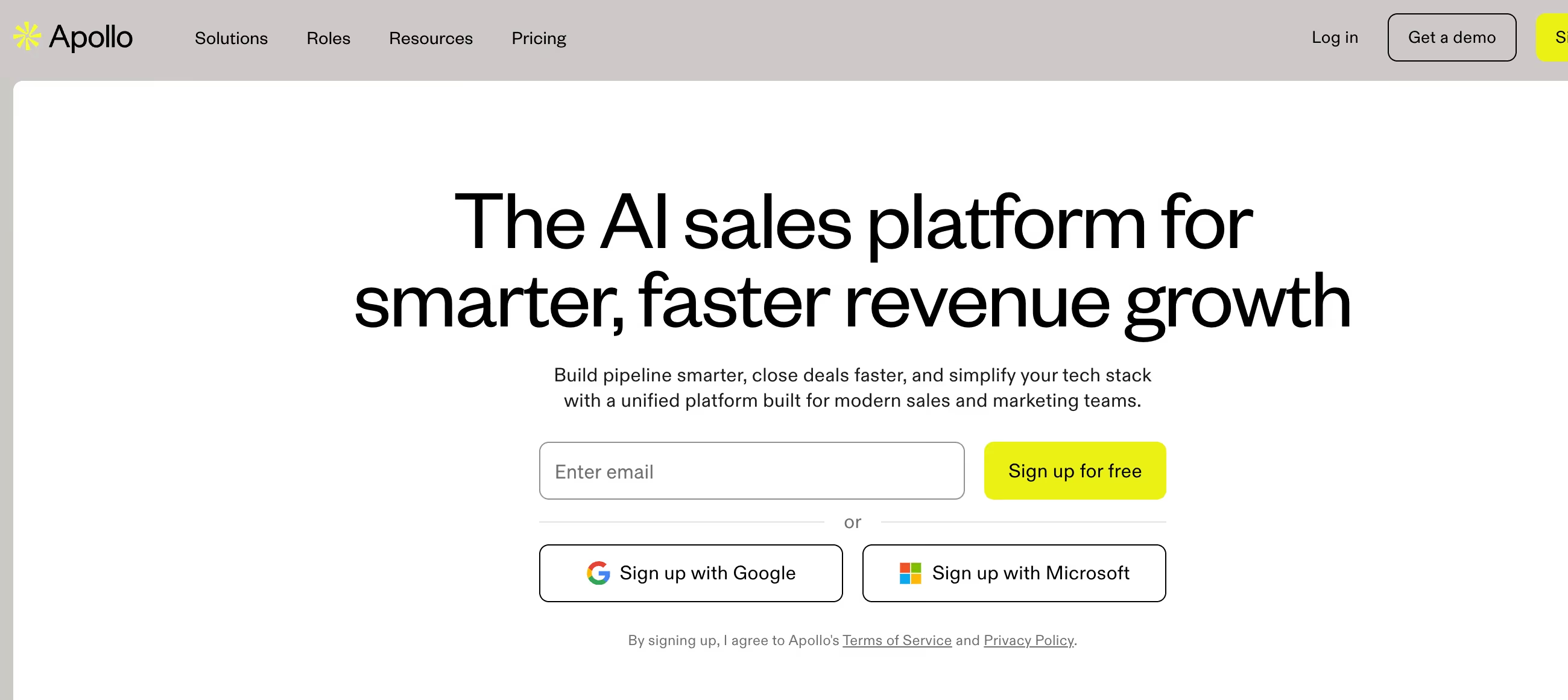
Is Apollo Right for You?
A startup founder signed up for Apollo's free plan and booked three demos in his first week — he'd never done outbound before, but the database filters and built-in sequences made it feel like he had a full sales team behind him.
On the other hand, a sales manager discovered that "unlimited email credits" didn't mean what she thought, mobile numbers ran out in days, and a fifth of her exported emails bounced.
That gap tells you everything about Apollo. We scored it 8.0/10: it's the platform that gave startups the same outbound infrastructure that used to require a six-figure annual tool budget. But data accuracy struggles to keep pace with the database's growth, and the credit system is more layered than the pricing page lets on.
⚠ Main limitation: The "unlimited email credits" only cover emails sent through Apollo — exporting contacts to your CRM is capped separately. If you need pristine data accuracy, you'll want a verification layer on top.
✔ Get it if: You want the most generous free plan in sales tools, you need mid-market capability at startup-friendly pricing, or you're tired of paying for a data provider, a sequencer, and a dialer as three different subscriptions.
All-in-one sales intelligence and engagement platform on a freemium model.
You're building outbound from scratch and want to start without spending a dollar. You'd rather have one platform that handles data, email, and calling than juggle four separate tools.
You need verified-clean data without adding a separate tool (try UpLead or Cognism), you want the best possible email deliverability (Instantly is purpose-built for that), or you need depth over breadth in any single feature.
Why Apollo?
Apollo launched in 2015 with a simple bet: premium B2B data shouldn't cost $15,000/year. ZoomInfo had the market locked behind enterprise contracts that startups couldn't touch.
Apollo offered the same type of data on a freemium model — and over a million sales professionals signed up. The platform has since grown from a contact lookup tool into a full go-to-market engine with sequences, a dialer, and pipeline management baked in.
One Login Instead of Four
Here's the problem Apollo solves: before it existed, a typical outbound stack meant one tool for contacts, another for email sequences, a third for calling, and a fourth for enrichment. Each costs money, each has its own login, and the data between them never syncs cleanly.
Apollo collapses that into a single subscription. The individual pieces aren't category-leading, but the combination at this price point means a 5-person team spends thousands instead of tens of thousands per year.
The Free Plan That Built the User Base
This isn't a 14-day trial with a credit card on file. It's a permanent free tier with 10,000 email credits per month, basic sequences, a Chrome extension for LinkedIn prospecting, and enough functionality to run real campaigns.
Solo founders build genuine pipeline on it without spending anything. That generosity is strategic — it's how Apollo got a million users — but the value at $0 is real regardless of the motive.
The Filter Depth That Makes It Work
A large database is useless if you can't find the right people in it. Apollo's 50+ search filters — job title, seniority, company size, revenue, technographics, funding stage, intent signals — turn a massive pool of contacts into precise targeting.
You're not searching for "marketing people at tech companies." You're finding "Director of Demand Gen at Series B SaaS companies with 50-200 employees using HubSpot in North America." That specificity is the difference between spray-and-pray and strategic outbound.
The Verdict: Our Assessment
8.0/10 — Apollo changed who gets to do outbound. Before it existed, serious B2B prospecting required enterprise budgets. Now a solo founder can run professional outbound on a free plan, and a growing team can replace a multi-tool stack for a fraction of what the alternatives cost.
The trade-off is that breadth comes at the expense of depth, and a database this large will always have freshness challenges.
Criteria | Score | Verdict |
|---|---|---|
Database & Filtering | 9/10 | The largest accessible B2B database at this price point, with filters precise enough to turn volume into targeted prospecting |
All-in-One Value | 9/10 | Data, sequences, dialer, enrichment, and CRM sync replace what used to require four separate subscriptions |
Free Tier | 10/10 | A permanent free plan with real functionality — not a demo, not a trial, a genuine foundation for early-stage outbound |
Data Freshness | 5/10 | The database's size makes maintenance hard — expect some outdated contacts and plan for a verification step in your workflow |
Credit Clarity | 4/10 | Separate pools for email, mobile, and export with limits that don't match the "unlimited" messaging on the pricing page |
Feature Depth | 6/10 | Every feature works well enough, but teams with specific needs will eventually want a specialized tool layered on top |
⚠ Trade-offs: You're trading specialization for consolidation. Apollo rewards teams that value having everything in one place and penalizes those who need the best version of any single capability.
Fit by Business Type
Strongest for startups and growing SDR teams; weakest for enterprise ops and accuracy-critical prospecting.
Strong Fit
✔ Startups and early-stage companies (10/10) — the free plan gets you running, paid plans replace a multi-tool stack, and the 50% discount for small teams makes it even more accessible.
✔ SDR teams of 3-15 (9/10) — the sweet spot where one platform covering data, email, and calling delivers the most value relative to assembling the same capabilities separately.
✔ SaaS companies (9/10) — the technographic and funding-stage filters are purpose-built for finding companies that match a software product's ideal buyer profile.
Moderate Fit
◑ Agencies managing client outreach (6/10) — the platform handles prospecting well, but per-seat pricing and credit pools create complexity across multiple client accounts.
◑ Recruiting teams (5/10) — the contact database works for sourcing candidates, but the platform is optimized for sales workflows, not recruitment pipelines.
Poor Fit
✗ Enterprise sales organizations (4/10) — larger teams need the compliance depth, premium accuracy, and advanced analytics that purpose-built enterprise platforms provide.
✗ European-focused teams (4/10) — GDPR compliance requires more rigorous data handling than Apollo's broad-market approach delivers.
✗ Teams that need precision over volume (4/10) — if every contact must be verified before outreach, you want a tool that guarantees accuracy rather than one that prioritizes coverage.
What Users Say: Reviews & Verified Experiences
User ratings: 4.8/5 on G2 with 7,500+ reviews — one of the most-reviewed sales tools on the platform. The high rating reflects genuine value, though the most frequent concerns around data quality and credit limits surface consistently in longer reviews.
What Users Love
✩ Stack simplification: Users consistently praise having "data, enrichment, and outreach in one place, without bouncing between different tools" — the consolidation is the value that keeps teams loyal even when individual features have rough edges (G2).
✩ Getting started fast: Reviewers describe being up and running quickly, with the support team earning high marks for helping new users configure their workflows during onboarding (G2, Go4Database review).
✩ Search precision: The ability to "save and filter complex personas" speeds up prospecting for teams with well-defined buyer profiles — the filtering is consistently cited as the strongest individual feature (G2, Scalelist review).
Common Complaints
⚠ Data decay at scale: "The size of the database makes it hard to keep clean — expect ghosts and bounces" is the most common criticism across review platforms (G2, Scalelist review).
⚠ Credit confusion: The distinction between platform email credits and export credits trips up buyers who budget based on the "unlimited" messaging without reading the fine print (Scalelist review, SMARTe analysis).
⚠ Breadth vs. depth: Multiple reviewers describe the platform as "a mile wide and an inch deep" — the sequencer, dialer, and enrichment all work but none matches what dedicated tools in each category deliver (Scalelist review, SyncGTM).
What Apollo Users Typically Achieve
You'll Be Prospecting Like a Funded Company on Day One
The shift users describe most often isn't about any single feature — it's about capability. Yesterday you were Googling email formats and sending individual LinkedIn messages. Today you have a searchable database, automated follow-ups, and a phone dialer.
You look and operate like a company that's been doing outbound for years, even if you set up your account this morning. For founders who've been putting off outbound because the tooling felt out of reach, that shift happens in an afternoon.
Your Prospecting Will Get Sharper Every Week
The real power shows up after a few campaigns. You'll notice which job titles respond, which company sizes engage, which industries ignore you. Apollo's filters let you act on those patterns immediately — tightening your targeting based on actual results rather than assumptions.
Teams describe this feedback loop as the moment outbound stops feeling like guesswork and starts feeling like a system. The data drives the strategy, and the strategy improves the data you collect.
You'll Eventually Want Specialized Tools on Top
⚠ This isn't a criticism — it's the natural progression. As your outbound matures, you'll identify specific gaps: deliverability that needs a dedicated sending tool, call analytics that need conversation intelligence, or data accuracy that needs a verification layer. The teams that succeed with Apollo long-term treat it as the foundation they build on, not the ceiling they operate under. Start here, scale by adding, not by replacing.
💡 Test the free plan against your specific ICP before paying — your experience depends heavily on how well Apollo covers your target market. Add email verification to every export before outreach.
Apply for the startup discount before signing up if you have fewer than 20 employees. And read the credit system documentation carefully — understanding what "unlimited" actually means will save you from the most common frustration new users report.
3 Critical Mistakes to Avoid
Mistake #1: Sending to Raw Exports Without Verification
A team exports 3,000 contacts and fires them straight into an email campaign. The bounce rate hits 18%. Their sending domain gets flagged by Gmail and Outlook, and deliverability drops across every campaign they run afterward — not just the one with bad data.
Three months of sender reputation building is undone in a single afternoon because they treated an export as a finished list.
⚠ The Fix: Run every export through a verification service before loading it into your outreach tool. NeverBounce, ZeroBounce, or similar — the cost is $5-20 per thousand emails, which is trivial compared to rebuilding a damaged sender reputation. Build this into your standard workflow and never skip it, regardless of how clean the data looks in preview.
Mistake #2: Expecting Export Credits to Match Email Credits
A sales manager budgets based on "unlimited email credits" and plans to export 5,000 contacts per month into HubSpot for sequencing through Outreach. On day one she discovers that exports are capped at 1,000 on Basic.
Her entire workflow — built around external tools processing Apollo data — hits a wall before a single email goes out. She's locked into a plan that doesn't support how her team actually operates.
⚠ The Fix: Before choosing a plan, map your actual workflow. If you send through Apollo's platform, the email credits work fine. If you export to an external CRM or outreach tool, the export cap is your real constraint. Teams that rely on external sending need Professional or Organization tiers — or need to rethink their workflow to send through Apollo directly.
Mistake #3: Buying Organization When Professional Covers Your Needs
A 5-person team signs up for Organization because the international dialer and SSO sounded important during the sales call. Six months in, they've never dialed an international number and their company doesn't use SSO. That's $200/month in features they'll never touch — $2,400/year that could have funded another tool or another hire.
⚠ The Fix: Start on Professional and upgrade only when you hit a specific wall. Organization's key additions are international calling, transcription, and enterprise security. If you don't prospect globally or need SSO, Professional gives you everything that matters at $40/user/month less. Upgrade when the gap costs you more than the price difference — not when features sound appealing in a demo.
Frequently asked questions
How much does Apollo.io cost?
Free: 10,000 email credits/month, 5 mobile credits, basic features. Basic: $49/user/month ($39 annual) — unlimited platform email, 75 mobile credits, CRM integrations. Professional: $79/user/month ($59 annual) — dialer, call recording, A/B testing, AI email writing. Organization: $119/user/month ($99 annual, 3-user min) — international dialer, call transcription, SSO. 20% annual savings. 50% startup discount for companies with ≤20 employees.
How does Apollo compare to ZoomInfo?
ZoomInfo has higher data accuracy, deeper intent data, and more enterprise features, but costs $15,000-30,000+/year with opaque pricing and annual contracts. Apollo offers a larger accessible database (275M+ contacts), built-in outreach tools, and transparent pricing starting at $0. Choose ZoomInfo for enterprise-grade data accuracy and compliance. Choose Apollo for all-in-one capability at a fraction of the price.
Is Apollo's data accurate?
It varies. The database is the largest at this price point (275M+ contacts), but maintaining accuracy across that volume is challenging. Users report 15-20% bounce rates on some segments, with stronger coverage for US companies and common job titles. Always run exported emails through a verification service before high-volume outreach. Think of Apollo's data as a strong starting point that needs a quality filter, not a finished verified list.
What are the credit limits?
Apollo uses separate credit pools: email credits (sending through the platform), mobile credits (accessing phone numbers), and export credits (downloading data to CSV/CRM). 'Unlimited email credits' means sending via Apollo — not exporting. Export limits range from 1,000 (Basic) to 2,500+ (Organization) per month. Mobile credits range from 5 (Free) to 150 (Organization). Exceeding limits triggers overage charges.
Does Apollo have a startup discount?
Yes — 50% off annual Basic or Professional plans for one year, for up to five seats. Available to startups with 20 or fewer employees. Apply through Apollo's Startup Promotions program before signing up for a regular plan. The discount also includes access to startup-focused webinars and educational resources.
Can Apollo replace my entire sales stack?
For most startups and mid-market teams, largely yes. Apollo combines data, email sequences, a dialer, enrichment, and basic CRM features. But each individual feature is adequate rather than best-in-class. Teams with specific needs — highest data accuracy (Cognism), advanced email deliverability (Instantly), or enterprise sequencing (Outreach) — will add specialized tools on top. Apollo is the best starting foundation, not necessarily the final destination.