Is Gong Right for You?
A VP of Sales at a 60-person SaaS company deployed Gong and within a quarter had identified exactly why deals were stalling — reps were spending 70% of discovery calls talking instead of listening.
The coaching scorecards surfaced the pattern across the entire team, and conversion rates improved measurably once managers had data to coach from instead of opinions. He calls it the most important hire he ever made that wasn't a person.
On the flip side, a 15-person startup signed a multi-year Gong contract at roughly $100,000 for year one — platform fee, per-user licenses, onboarding, and the Engage add-on they thought they needed.
Six months in, only 8 reps actively used it, most treating it as a glorified note-taker. The expensive features went largely untouched, and the contract's early termination penalty meant they couldn't walk away without paying 50-100% of the remaining balance.
We scored it 8.4/10: it's the category leader in revenue intelligence, and the conversation insights genuinely transform how sales teams coach, forecast, and manage deals.
But the pricing is opaque, the implementation is heavy, and the ROI only materializes if your team actually adopts it beyond basic call recording — which is now essentially a commodity feature.
Pricing isn't public and requires a sales conversation. Industry benchmarks place the Foundations license at roughly $1,400-1,600 per user per year, with a mandatory platform fee of $5,000-50,000 depending on team size, plus onboarding costs.
Forecast and Engage are now separate add-ons following the 2025 restructure. Used by 5,000+ companies including LinkedIn, Shopify, Slack, and Zillow. Rated #1 on G2 with 6,500+ reviews averaging 4.7/5.
⚠ Main limitation: The pricing is designed for mid-market and enterprise — effective per-user costs run 2-3x higher than the quoted seat rate once you add platform fees, onboarding, and add-ons.
Implementation typically takes 8+ weeks with dedicated RevOps support. And transcription, Gong's original differentiator, is now commoditized — Zoom, Teams, and dozens of cheaper tools all transcribe calls. The value has shifted to the intelligence layer built on top, which requires organizational buy-in to deliver returns.
✔ Get it if: You have 25+ sales reps where individual call coaching doesn't scale, you need forecast accuracy grounded in buyer behavior rather than gut feel, or you want to systematize what top performers do differently and teach it to the rest of the team.
Gong is a revenue intelligence platform that sits quietly behind every sales conversation — calls, video meetings, and emails — recording, transcribing, and analyzing them with AI trained on billions of real sales interactions.
Your sales team is large enough that managers can't sit on every call, and you need AI to surface what's actually happening in conversations across the pipeline. You want forecasting built on real buyer signals, not rep optimism.
Your team is under 15 people (the cost per rep is disproportionate at small scale), you primarily need call recording and transcription (cheaper tools handle that now)…
Why Gong?
Gong launched in 2015 to solve a problem every sales manager lived with: you have no idea what actually happens on your team's calls. Reps report what they remember (or want you to believe), CRM notes are inconsistent, and coaching is based on vibes rather than data.
Gong made every conversation searchable, analyzable, and coachable — and that capability built a category that didn't exist before it.
From Call Recording to Revenue Intelligence
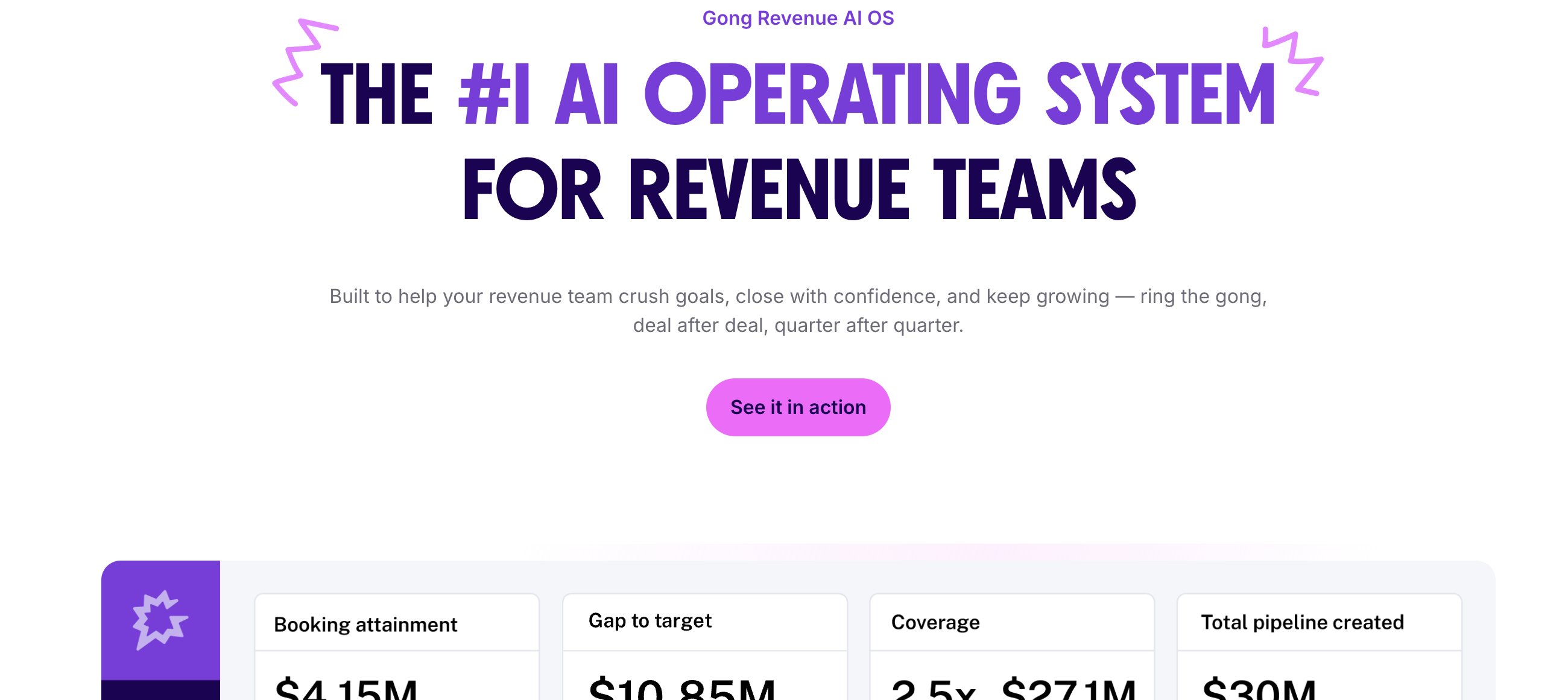
The platform started as conversation intelligence and expanded into a full Revenue AI Operating System. Deal intelligence scores every opportunity based on 300+ data points — actual buyer behavior, not rep self-reporting.
The forecasting engine builds predictions from real conversation signals, not the pipeline stages that reps optimistically update. Coaching tools surface exactly where individual reps diverge from the patterns that close deals.
This evolution from "record calls" to "understand your entire revenue motion" is what justifies the enterprise pricing for teams that use it fully.
AI Agents: The 2025-2026 Evolution
Gong's newest capability is AI agents that don't just surface insights but take action. The Data Extractor agent pulls structured information from calls into CRM fields automatically. The Deep Researcher agent analyzes account history across conversations.
Follow-up agents draft next-step emails based on call content. Pipeline agents flag when deal data in the CRM contradicts what happened in the actual conversation.
This shift from "here's what happened" to "here's what to do about it" represents where the platform is heading — and it's the kind of automation that cheaper conversation intelligence tools can't replicate.
The Category Leader Position
5,000+ customers. 4.7/5 on G2 across 6,500+ verified reviews. Named #1 Best Software Product by G2 for multiple years. LinkedIn, Shopify, Slack, Twilio, and Zillow run their revenue teams on it.
This adoption matters because Gong's intelligence improves with scale — the AI models are trained on billions of real sales interactions, giving them a data advantage that newer entrants can't match from a cold start.
The Verdict: Our Assessment
8.4/10 — Gong earned the category leader position because the conversation intelligence and deal insights genuinely change how sales teams operate. When fully adopted, it replaces guesswork with data across coaching, forecasting, and pipeline management.
The AI agents introduced in 2025-2026 push the platform from "insights you read" to "actions that happen automatically." For teams that commit to adoption, the ROI is measurable and significant.
The pricing story is harder. Opaque quotes, mandatory platform fees, multi-year lock-ins, and the 2025 restructure that unbundled previously-included features have pushed effective costs to levels that make the ROI calculation tighter than it was three years ago.
Gong is worth it for the right team — but "the right team" is getting more specific as cheaper alternatives close the feature gap on basic conversation intelligence.
Criteria | Score | Verdict |
|---|---|---|
Conversation Intelligence | 10/10 | The deepest conversation analysis in the market — trained on billions of real sales interactions with a data moat competitors can't replicate from scratch |
Deal Intelligence | 9/10 | 300+ signal deal scoring based on actual buyer behavior transforms pipeline reviews from opinion-based to evidence-based |
Coaching | 9/10 | Scorecards, snippets, and talk-time benchmarks systematize what great selling looks like — the feature managers value most |
AI Agents | 8/10 | Moving from insights to automated actions — follow-ups, CRM updates, and pipeline corrections that happen without human intervention |
Pricing Transparency | 2/10 | No public pricing, mandatory platform fees, forced add-on unbundling, and multi-year lock-ins create a buying experience that frustrates even advocates |
Small Team Fit | 3/10 | Platform fees disproportionately penalize teams under 25 — effective per-user costs at small scale reach $4,000+/year before add-ons |
⚠ Trade-offs: The most powerful revenue intelligence at the cost of the category's most opaque and expensive pricing. Gong rewards full organizational commitment — and punishes partial adoption with expensive underutilization.
Fit by Business Type
Strongest for mid-market and enterprise B2B sales teams; weakest for small teams and non-sales use cases.
Strong Fit
✔ Mid-market B2B sales teams 25-200 reps (10/10) — the sweet spot where individual coaching doesn't scale but the budget supports enterprise tooling; deal intelligence and forecasting transform pipeline management.
✔ Enterprise revenue organizations (9/10) — 5,000+ companies including Fortune 10 names validate Gong at scale; AI agents and advanced forecasting serve large, complex sales motions.
✔ Sales enablement teams (9/10) — coaching scorecards, snippet libraries, and conversation analytics provide the data foundation that enablement programs need to be evidence-based.
Moderate Fit
◑ Customer success teams (7/10) — conversation intelligence applies to renewal and expansion calls, though Gong's primary focus remains new business sales motions.
◑ Sales-led SaaS companies 15-25 reps (6/10) — valuable but the platform fee creates disproportionate per-user costs at this team size; cheaper CI tools may deliver 80% of the value.
Poor Fit
✗ Teams under 15 reps (3/10) — the platform fee alone can exceed what the entire team generates in incremental revenue from better coaching; simpler tools like Fireflies or Otter serve basic needs.
✗ Non-sales teams wanting meeting transcription (2/10) — Zoom, Teams, and Otter handle transcription at a fraction of Gong's cost; the revenue intelligence layer is wasted on non-sales conversations.
✗ Budget-conscious startups (3/10) — six-figure annual commitments with multi-year lock-ins create financial risk that early-stage companies shouldn't take on for tooling.
What Users Say: Reviews & Verified Experiences
Gong holds 4.7/5 on G2 across 6,500+ verified reviews — one of the highest ratings for any enterprise sales tool. The praise is deep and specific: managers describe it as the tool that finally gave them visibility into what happens on calls.
The criticism is equally specific: the pricing, the lock-in, and the gap between what you pay for and what your team actually uses.
What Users Love
✩ Single source of truth: "Gong has become the single source of truth for our sales team — from deal management to forecasting, it's been really easy to gain adoption across the team" captures how embedded the platform becomes once teams commit (G2).
✩ Coaching transformation: "Pull back the curtain on top producers' talk tracks and transform average sellers into stars" — managers describe Gong as the tool that makes coaching objective rather than subjective (G2).
✩ Low-maintenance intelligence: "Gong is such a low-maintenance tool that I can set it up to work exactly how I need it to — it automatically records all of my calls so I can review them and gives a great breakdown so I can follow up seamlessly" (Gartner Peer Insights).
Common Complaints
⚠ Pricing opacity: "Gong is expensive and the pricing is opaque, with a mandatory platform fee on top of per-seat costs that disproportionately penalizes smaller teams" — the most consistent criticism across all review platforms (Fritz AI review).
⚠ Feature unbundling: "They are taking pieces that are core to the users now and making them additional fees" — the 2025 restructure that separated Forecast and Engage into paid add-ons frustrated existing customers at renewal (Gartner Peer Insights).
⚠ Walled ecosystem: "They want to keep all call knowledge in Gong which means it doesn't play nice with other tools" — data portability concerns affect teams wanting to integrate conversation intelligence into broader tech stacks (Gartner Peer Insights).
What Gong Users Typically Achieve
Your Pipeline Reviews Will Become Evidence-Based
The transformation sales leaders describe most consistently: pipeline meetings stop being interrogations and start being strategy sessions.
Instead of asking "how do you feel about this deal?" and getting optimistic answers, you pull up the Deal Board and see exactly what happened in the last conversation — was the economic buyer present?
Did pricing come up? Were next steps defined? The data shifts the conversation from opinion to evidence, and the deals that are actually at risk get attention before they stall rather than after they're lost.
Your Coaching Will Scale Without You
A sales manager with 12 reps can't listen to every call. Before Gong, coaching was limited to the calls you happened to join and the deals you happened to review. After Gong, every call is scored, every pattern is visible, and the system flags specific coaching moments automatically.
The rep who talks through pricing objections too fast gets a targeted suggestion. The rep who never asks discovery questions sees the benchmark. Top performers' best moments become training clips the entire team can study. Coaching becomes systematic rather than opportunistic.
Your Budget Conversation Will Be the Hardest Part
⚠ Every Gong evaluation ends with the same challenge: justifying the cost. The platform works — that's not the question. The question is whether the improvement in win rates, forecast accuracy, and rep performance generates enough incremental revenue to justify what is genuinely one of the most expensive tools in the sales stack.
For teams above 50 reps, the math usually works clearly. For teams of 15-25, it's tighter. For teams under 15, it rarely pencils out when cheaper conversation intelligence tools deliver 70-80% of the core value.
💡 Go through the evaluation demo with your actual team's calls if possible — Gong's value is most visible when you see your own conversations analyzed, not a demo account. Negotiate the platform fee aggressively — it's the most variable component and the one procurement teams have the most leverage on.
Start with Foundations only and add Forecast or Engage later based on actual usage, not the sales team's recommendation. And build an adoption plan before signing — the teams that get ROI from Gong are the ones where managers actively use coaching features, not the ones that just record calls.
3 Critical Mistakes to Avoid
Mistake #1: Buying the Full Bundle Before Validating Adoption
A sales director signs a contract for Foundations plus Forecast plus Engage for 40 reps at roughly $3,000/user/year — a $120,000 annual commitment. Eight months later, only 25 reps use Gong regularly, and most of them just read call summaries.
Nobody uses Engage for sequencing (they prefer Outreach). Forecast gets checked by two managers. The company is paying $120,000 for what is effectively a $50,000 call recording and summary tool — with 18 months left on a contract they can't exit without paying 50-100% of the remaining balance.
⚠ The Fix: Start with Foundations only. Use it for 6 months and measure actual adoption — how many reps review their own calls? How many managers use coaching scorecards? How often does the deal intelligence change a pipeline decision?
Add Forecast only when your forecasting process genuinely needs it. Add Engage only if your team doesn't already have a sequencer. Every add-on should solve a demonstrated problem, not a theoretical one your Gong AE described during the sales process.
Mistake #2: Treating Gong as a Recording Tool
A team deploys Gong and reps treat it like an expensive Zoom recorder — they glance at summaries after calls and occasionally share a funny clip in Slack. Nobody uses the deal scoring. Nobody reviews talk-time ratios. Managers run pipeline reviews the same way they did before, never opening the Deal Board.
The platform is technically deployed but operationally unused, and the $1,600/user/year spend generates approximately zero incremental value beyond what the free Zoom transcription already provided.
⚠ The Fix: Gong's value lives in the coaching and intelligence layers, not the recording. Build coaching into your operating rhythm — weekly scorecard reviews, monthly talk-track analysis, quarterly pattern identification across the team.
Make deal intelligence part of pipeline meetings — pull up the Deal Board and use it, not alongside it. The teams that get ROI from Gong are the ones that changed how they work, not the ones that just added a new tool to the existing process.
Mistake #3: Signing a Multi-Year Contract Without an Exit Plan
A company signs a 3-year Gong contract with a 7% annual uplift and auto-renewal. Year two, the company downsizes and reduces the sales team by 40%. They're now paying for 60 licenses but only have 36 reps — and the contract doesn't allow seat reductions until renewal.
The early termination penalty would cost more than riding out the remaining months. They're locked into paying for seats nobody uses while cheaper alternatives serve their now-smaller team more appropriately.
⚠ The Fix: Negotiate contract flexibility before signing, not after. Push for annual contracts instead of multi-year (even if the per-user rate is slightly higher). Negotiate seat reduction rights tied to company size changes. Remove or cap auto-renewal uplifts.
And most importantly, right-size the initial deployment — buy licenses for reps who will actively use the platform, not for the headcount you hope to have in 18 months. Overbuying to get volume discounts is only a discount if every seat gets used.
Frequently asked questions
How much does Gong cost?
Gong doesn't publish pricing. Industry benchmarks for 2026: Foundations license approximately $1,400-1,600/user/year. Mandatory platform fee of $5,000-50,000/year depending on team size. Onboarding fees of $5,000-15,000+. Forecast add-on approximately $700/user/year. Engage add-on approximately $800/user/year. Effective first-year cost for a 25-person team runs roughly $100,000. Multi-year contracts are standard with auto-renewal uplifts of 5-15%. No monthly billing option.
Is Gong worth it for small teams?
Usually not. The mandatory platform fee ($5,000-50,000) spreads across fewer users, pushing effective per-user costs to $3,000-4,000+ per year for teams under 25 reps. At that price, cheaper conversation intelligence tools like Fireflies ($19/user/month), Chorus, or even Zoom's native AI deliver 70-80% of the basic call analysis value. Gong's advantage — deal intelligence, advanced coaching, forecasting — matters more at scale.
How does Gong compare to Chorus?
Gong is the category leader with deeper AI models trained on more data, stronger deal intelligence, and a broader ecosystem. Chorus (now owned by ZoomInfo) integrates with ZoomInfo's data platform and tends to price lower. Choose Gong if deal intelligence and coaching depth are priorities and budget allows. Choose Chorus if you're already in the ZoomInfo ecosystem or need a lower price point for comparable conversation intelligence.
What changed in Gong's 2025 pricing restructure?
Gong shifted from a bundled model to modular pricing, separating Forecast and Engage into paid add-ons. The platform fee reportedly increased from roughly $10,000 to up to $50,000/year. Features previously included in standard plans now require separate purchases. Industry estimates suggest effective per-user costs rose 25-56% between 2023 and 2026. Existing customers report more contentious renewal conversations.
How long does Gong implementation take?
Typically 8+ weeks for full deployment, including CRM integration, meeting platform connections, coaching scorecard configuration, and team training. Larger organizations may take longer. Most deployments require dedicated RevOps support to drive adoption. The implementation is heavier than most modern SaaS tools, but the depth of integration is also what makes the intelligence layer valuable.
Can I try Gong before buying?
No — there's no free trial, no freemium plan, and no self-serve signup. Every evaluation begins with a demo booked through Gong's sales team, followed by a custom quote. This is standard for enterprise revenue intelligence but creates a higher commitment barrier than most SaaS tools. Ask during the demo whether they'll run your actual team's calls through the platform as a proof-of-concept.